
The Jiangmen Underground Neutrino Observatory, JUNO, released its first neutrino measurements on Nov 19, 2025, after collecting 59 effective days of data. The underground experiment in Guangdong, southern China, had begun scientific operation on Aug 26. Its first results concern the parameters governing neutrino oscillation, the changes between neutrino types as they travel. Wen Liangjian, deputy director of the Institute of High Energy Physics, put the initial precision at 1.5–1.8 times that of previous experiments. The result also left a difference between solar and reactor neutrino measurements at about 1.5 standard deviations, far short of an established discrepancy. Determining the ordering of neutrino masses remains a future objective. Behind these early measurements sits a system of transparent structures, purified liquids, light sensors and calibration equipment built to distinguish rare interactions from background signals. The first measurement period ran through Nov 2, 2025, following commissioning and the start of physics acquisition.
Building the transparent vessel
JUNO's acrylic sphere was complete by October 2024. Its walls are 120 millimetres thick, and the vessel weighs more than 600 tonnes. The container must hold the scintillator while remaining submerged in purified water. The different liquids impose a sustained buoyant load of approximately 3,000 tonnes on the structure, making support under operating conditions a separate challenge from supporting an empty vessel during assembly. The planned filling sequence addressed this change in loading. Water would initially enter the sphere as well as the surrounding pool, protecting the vessel against an excessive difference in pressure. Scintillator would then replace the water gradually. The project had begun in 2013, followed by civil construction in 2015. By October 2024, the acrylic installation had reached completion while assembly of the surrounding steel structure and photomultiplier tubes continued. The installation deadline then anticipated for the end of November was a forecast; the transition to filling followed the remaining construction work. The October 2024 collaboration brought together 750 scientists and engineers across 74 research institutions in 17 countries and regions.
From installation to liquid filling
Detector installation extended from December 2021 to December 2024. The completed target contains 20,000 tonnes of liquid scintillator, supplied through a replacement operation lasting roughly six months. During filling, operators had to coordinate liquid levels inside and outside the acrylic container, keeping their difference to a few centimetres. The flow measurements used for this coordination had an uncertainty below 0.5%.

The detector lies about 700 metres underground, approximately 53 kilometres from the Taishan and Yangjiang nuclear power plants. The reactors provide the antineutrinos used for its principal oscillation measurements. Close to the sensors, underwater electronics shorten the connection carrying the initial signals and help limit noise. Once the pool is filled, those modules become inaccessible for ordinary repair. Component selection, production controls and testing therefore preceded installation. The completion of scintillator filling brought the mechanical installation and liquid-handling stages together with equipment intended to remain in place during extended scientific operation. Performance testing also involved facilities in Montegrotto, alongside work on component design and production before the equipment entered its underwater setting.
A purification chain for the active liquid
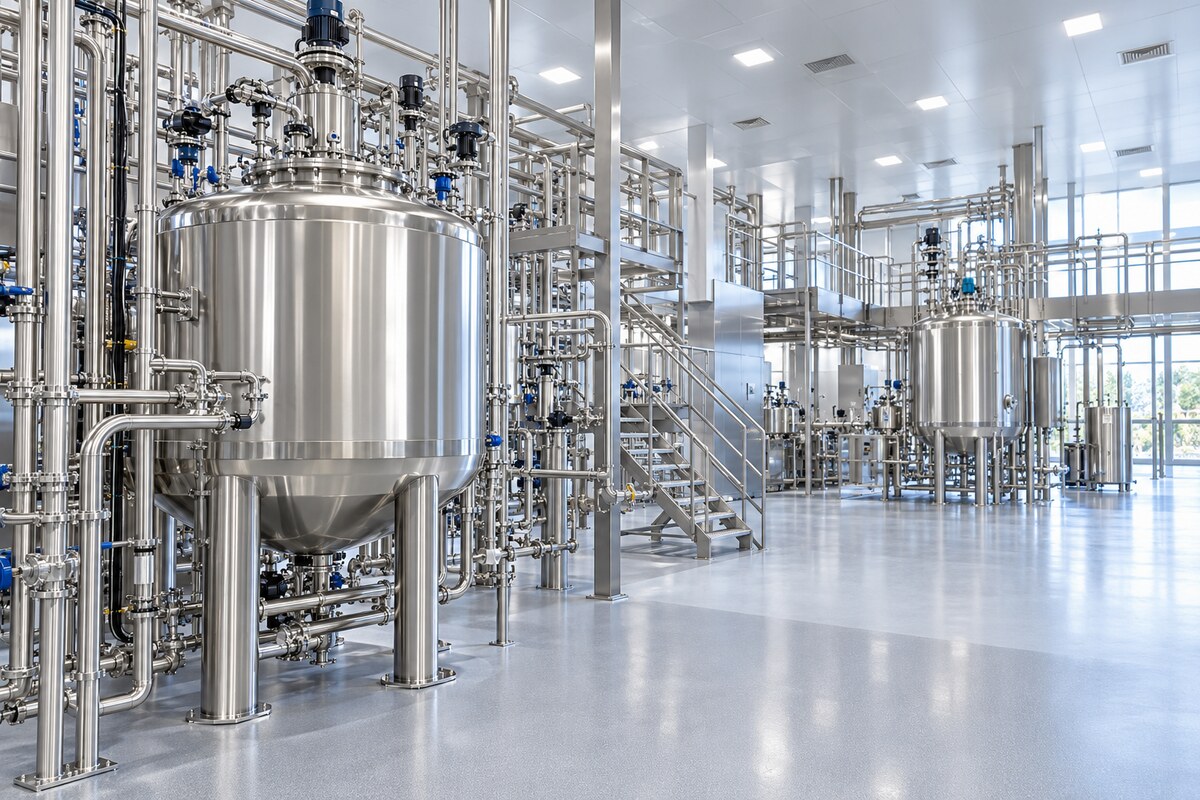
The scintillator preparation system combines several processes with different tasks. Its solvent is linear alkylbenzene, or LAB. The mixture uses 2.5 grams per litre of PPO as a fluor and 3 milligrams per litre of bis-MSB to shift the emitted light's wavelength. Large-scale purification plants were designed for a nominal flow of seven cubic metres per hour. The sequence presented during commissioning in June 2024 comprised:
- Alumina filtration to improve the solvent's optical properties.
- Distillation under partial vacuum to remove heavy, high-boiling impurities.
- Washing and mixing the light-emitting ingredients into the solvent.
- Water extraction underground to remove polar radioactive contaminants and ions.
- Gas stripping to remove dissolved gaseous contaminants.
Optical transparency and radioactive cleanliness were separate specifications. The commissioning targets included an attenuation length above 20 metres at a wavelength of 430 nanometres and uranium and thorium impurities below 10−15 grams per gram. Samples taken after purification supported tests of the plants' performance before the main filling campaign. These were preparation targets and commissioning activities, rather than the final detector's measured response.

Checking scintillator before transfer
OSIRIS, the Online Scintillator Internal Radioactivity Investigation System, adds a separate monitoring stage before scintillator enters JUNO's central detector. It examines radioactive contamination in the liquid, particularly the background associated with uranium-238 and thorium-232 decay chains. Those contaminants can contribute signals that interfere with the intended neutrino measurements. In the configuration presented at the June 2024 Neutrino conference, OSIRIS contained 18 tonnes of scintillator and 550 tonnes of purified water, monitored by 76 large photomultiplier tubes. This describes the pre-detector at that commissioning stage. Its role is to examine the material before transfer into the much larger target, rather than to serve as another readout of the central sphere. The monitoring programme included a detection strategy and preliminary measurements of scintillator radiopurity.
Manufacturing protection around the light sensors
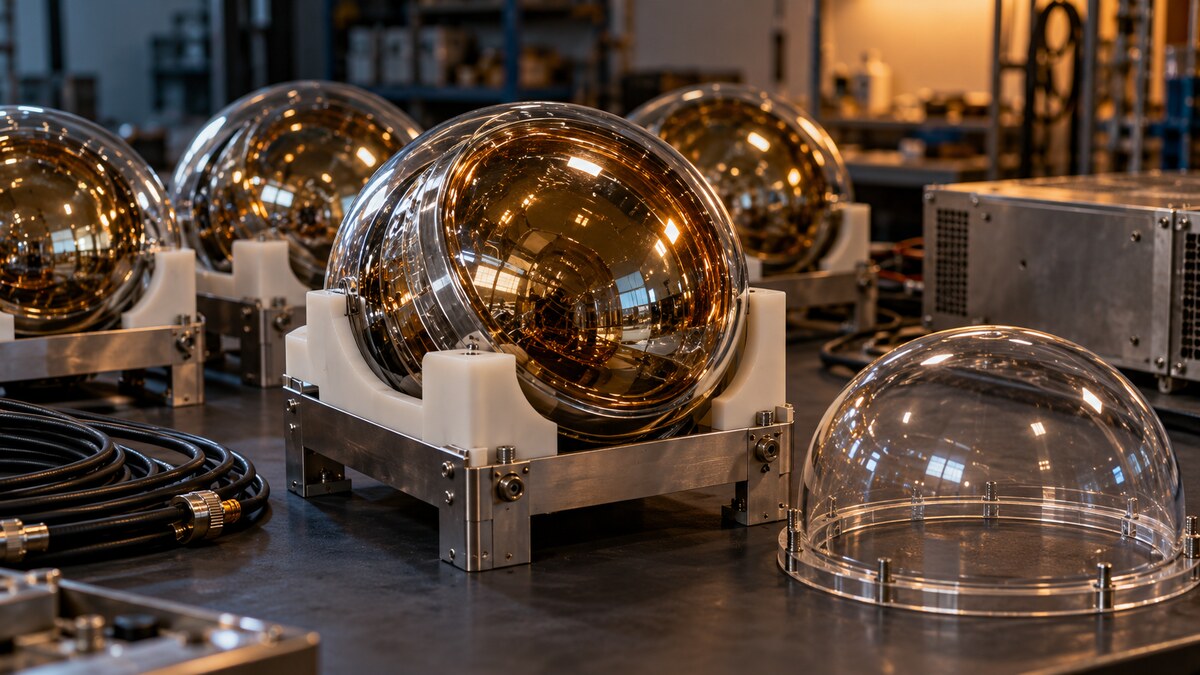
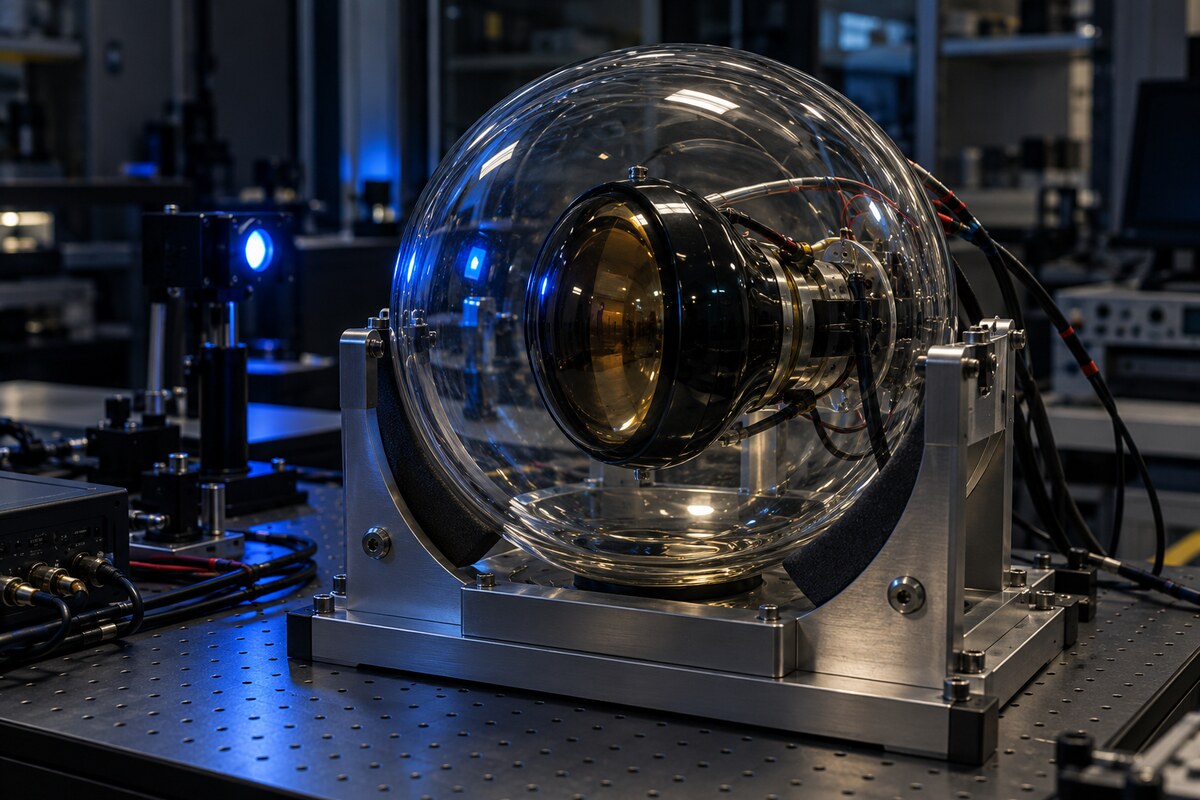
The large photomultiplier tubes contain evacuated glass bulbs. A broken bulb underwater can generate a pressure pulse capable of damaging neighbouring tubes. JUNO's protective housings combine a transparent acrylic upper cover with a steel lower cover, restricting the inrush of water if a tube implodes. The acrylic must transmit light while providing the required mechanical strength within the available installation clearance.
Production used injection moulding, followed by machining the holes. Moulding those openings directly had created weak weld lines where flowing acrylic rejoined. Early covers also exceeded the intended diameter by 1.5 millimetres. They could be used around the more widely spaced veto sensors, while a revised mould supplied the central detector. Between 2020 and 2022, manufacturing and subsequent inspection produced 21,900 qualified covers for delivery, a final yield of 82%. Three underwater tests at 0.5 megapascals above atmospheric pressure left neighbouring sensors undamaged after a deliberately induced implosion. These were validation tests on selected assemblies, rather than a measurement of lifetime reliability across the installed population. Measurements of fragments from two covers gave in-water transparency of 98.1%, with 0.5% uncertainty, at a wavelength of 420 nanometres.

Testing electronics before sealing the boxes
At Kunshan, the large-sensor electronics underwent production testing over approximately ten months, from October 2021 to July 2022. A total of 6,950 boards entered the programme. Of these, 6,886 passed, giving an acceptance yield of 99.1%. Eight boards failed the electronics test criteria; another 56 were rejected for assembly problems. Accepted units included equipment for the main detector, OSIRIS and a reserve of spare boards.
Assembled underwater boxes were tested for at least five days before final laser welding. Leak checks and a shorter electronics test followed sealing. The protocol covered network connectivity, response over different input-signal amplitudes, stability and internal operating conditions. Temperature, high-voltage readings and reference voltages were monitored alongside the digitised waveforms. Test settings and results entered a database so each board's production performance could be compared with later checks. Local staff assembled and exchanged boxes during the Chinese working day; European collaborators operated tests remotely afterward. The electronics acceptance programme used this arrangement during pandemic travel restrictions. Each underwater box combined three independently powered sensor channels with a control board that processed their digitised signals.
Reusing detector panels above the pool
Atmospheric muons crossing JUNO can generate unwanted signals resembling those sought in neutrino analyses. The Top Tracker sits above the main detector and identifies these passing particles. Its scintillator panels came from the earlier OPERA experiment and had been manufactured at the Hubert Curien Pluridisciplinary Institute, IPHC, between 2004 and 2006. The reused panels received new electronics developed largely at IPHC specifically for JUNO. Institute collaborators worked with Chinese, Italian and Russian colleagues to install the tracker’s 63 walls during the first half of 2025. The installation combined existing detector material with a replacement readout system adapted to its new experiment. This work preceded the first physics results announced that November and added a dedicated tracking instrument above the liquid detector.

Tracking a defined share of the muon flux
The tracker design arranges refurbished OPERA modules in three layers. Perpendicular planes of scintillator strips provide position information in two directions, allowing trajectories to be reconstructed across the layers. Its new trigger and readout electronics were designed for the background conditions at JUNO. The coverage described at the July 2024 ICHEP conference corresponds to approximately 30% of the muon flux. The tracker therefore supplies a defined sample of crossing particles, rather than a measurement of every muon passing the experiment. Its layered geometry and strip readout complement the light measurements in the liquid systems below.
Keeping calibration access clean and electrically quiet
A sealed calibration house interfaces with the chimney above the central detector. The steel chamber measures five metres by 2.5 metres by two metres and weighs approximately six tonnes. Gloveboxes permit access to equipment without opening the entire enclosure. Mechanical drives outside the chamber move calibration equipment through feedthroughs, while insulation separates the motors' utility grounding from the cleaner electrical ground used by the light-sensor system.
Nitrogen flushing limits oxygen and radon entering through this interface. Laboratory tests reached oxygen concentrations below five parts per million, against a requirement below ten. On-site leak testing gave a total leak rate below 2.9 × 10⁻⁵ millibar-litres per second. Tests of the cleaned chamber, its cable-loop equipment and nitrogen environment placed radon activity between two and 15 millibecquerels per cubic metre at 90% confidence. That interval applies to the tested chamber environment, rather than a direct measurement of contamination throughout the scintillator. The apparatus also underwent repeated motion tests to check the calibration mechanisms before operation. One hundred successful motion tests checked the mechanisms; this finite test series did not establish a lifetime failure rate.

Light pulses and sealed reference sources
Calibration equipment supplies reference signals with controlled properties. A customised ultraviolet laser system divides its light between a reference path and a detector path. Light travels through a 50-metre fibre to a diffuser, while the reference signal supports timing comparisons. Neutral-density filtering changes the light intensity over more than four orders of magnitude, allowing checks of sensor timing and the electronics' response at different signal levels.
The diffuser's timing uniformity and its intensity uniformity are distinct characteristics. Tests of the proposed ball geometry gave timing variations within approximately 0.25 nanoseconds, while its emitted intensity still varied substantially with direction. Detector simulations considered the effects of absorption and re-emission in the scintillator. Separate sealed calibration sources support energy-response measurements. Their customised titanium containers underwent laser welding, leak checks and water-contamination tests. Activity measurements before and after enclosure found no significant change within an uncertainty of roughly 10%. The source programme combines optical checks with reference radiation signals, each addressing a different part of the detector response. The ultraviolet wavelength was 266 nanometres, and the diffuser material was PTFE, used at the end of the detector fibre.
Simulating events without exhausting computer memory
JUNO's simulation software follows particles and the optical photons they produce, using Geant4 within the SNiPER framework. High-energy events can create millions of sensor-hit records. Memory-saving changes reduced one hit object's size from 248 bytes to 40 bytes and split large output collections into smaller parts. A multithreaded design also lets workers share detector geometry and physics information rather than loading a separate copy for every independent job.

Reproducibility required explicit handling of random-number sequences. The software resets them using the event identifier and a user-selected initial seed so the same event can be compared across serial and multithreaded processing. Four-thread tests reduced memory use below two gigabytes per core. Computing efficiency still depended on event type: gamma-ray events with similar processing times kept workers busy, while a particularly expensive muon event could leave other workers idle near the end of a job. The software development programme also considered assigning demanding optical-photon work to graphics processors. Those computational tests concern simulation performance, rather than a direct improvement in the measured neutrino parameters. Output tasks preserved event order while the worker tasks processed events dynamically, using a thread-safe shared buffer.
The detector's first measured operating performance
Water filling ran from Dec 18, 2024, to Feb 2, 2025, putting approximately 64,000 tonnes into the system over 46 days. Scintillator exchange followed from Feb 8 to Aug 22. The as-built central detector contains 17,596 large and 25,587 small photomultiplier tubes; additional sensors serve the water veto. These installed counts differ from the nominal design quantities used during earlier development.
At the detector centre, a 2.223-MeV gamma calibration yielded approximately 1,785 photoelectrons per MeV. Scintillator attenuation reached 20.6 metres at 430 nanometres. Energy nonlinearity was calibrated to better than 1%, while a source producing two 0.511-MeV gamma rays gave an energy resolution of 3.4% at the centre. These results retain their particular particle, energy and position conditions. The initial performance measurements also identified work still under way, including edge-response modelling, overlapping background signals and refined reconstruction. Calibration and analysis continued after the transition from construction to scientific data taking. By November 2025, 22 large tubes were non-operational, corresponding to 0.11% of those installed across the central and water systems.
















Leave a comment