
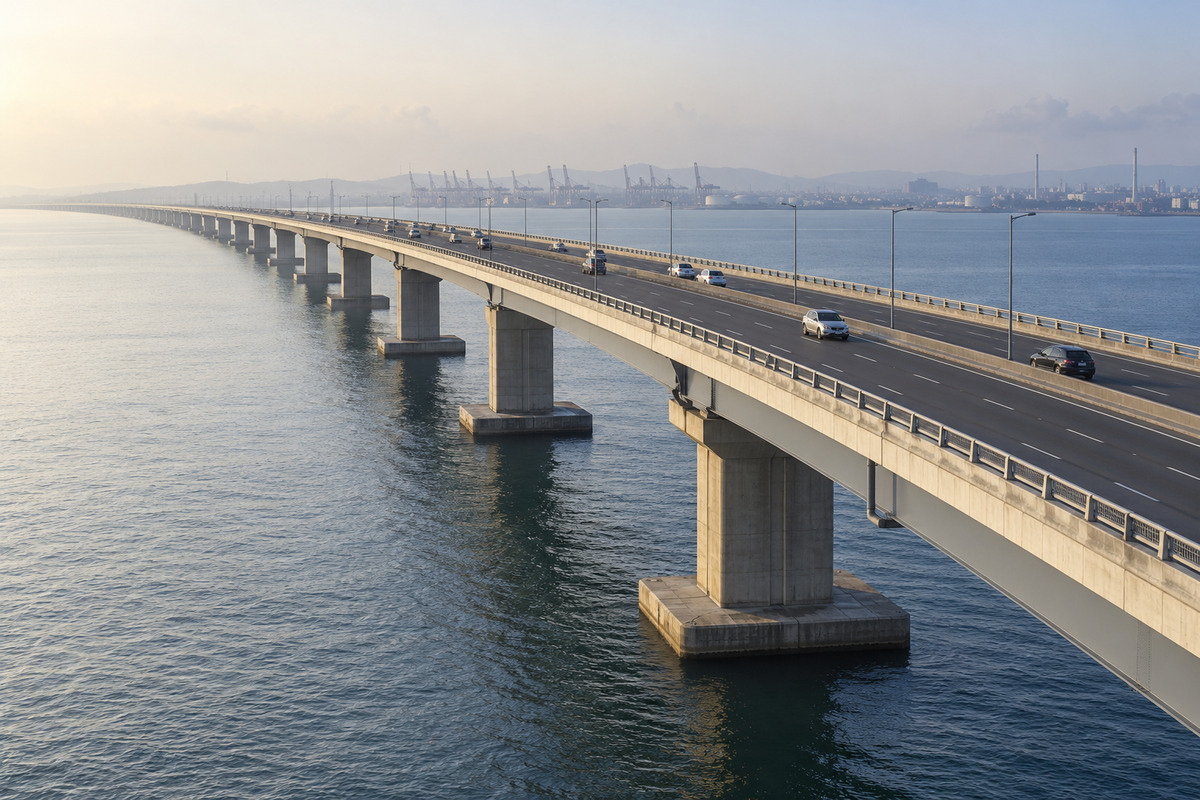
A crossing between two urban centres
Atal Setu was inaugurated by Prime Minister Narendra Modi on January 12, 2024, linking Mumbai with the satellite city of Navi Mumbai in India. The 21.8-kilometre, six-lane crossing is named after former prime minister Atal Bihari Vajpayee. At the opening, its reported construction cost was about 178 billion rupees, or $2.14 billion. The road connects South Mumbai with the mainland across the harbour. Mumbai’s population was reported as about 23 million at the time of opening.
The opening arrangements included a 250-rupee single-journey car toll, with larger vehicles charged more. Four-wheel vehicles had a maximum speed of 100 kilometres an hour; two-wheelers, tractors and autorickshaws were excluded. Traffic was expected to reach about 70,000 vehicles a day, according to The National. Navi Mumbai was already home to multinational companies, start-ups and educational institutions when the new harbour route was inaugurated. It opened as the country’s longest sea bridge.
From foundation ceremony to a regional link
The project’s foundation stone was laid on December 24, 2016. The crossing includes approximately 16.5 kilometres over the sea and about 5.5 kilometres on land, alongside the published overall length of 21.8 kilometres. These are rounded descriptions of the alignment. The official cost statement was more than 17,840 crore rupees. The completed project’s formal name is Atal Bihari Vajpayee Sewri–Nhava Sheva Atal Setu, retaining the names of the areas joined by the crossing.
Modi said construction had employed around 17,000 labourers and 1,500 engineers, with additional opportunities in transport and construction. The government’s intended network benefits extended beyond the two ends of the bridge: faster access to Mumbai International Airport and the then-upcoming Navi Mumbai International Airport, improved connections between Mumbai Port and Jawaharlal Nehru Port, and shorter journeys towards Pune, Goa and South India. Maharashtra Governor Ramesh Bais and Deputy Chief Minister Ajit Pawar were among those attending the inauguration.
Loans, contracts and delivery stages
The Japan International Cooperation Agency, or JICA, supported construction through three official development assistance loan tranches. At the inauguration, the agency placed their combined value at 242,459 million yen. The first agreement was signed in March 2017, the second in March 2020 and the third in February 2023. JICA linked the project to improved movement within the Mumbai Metropolitan Region and the growing transport needs of Maharashtra’s urban population, alongside the bridge’s role in connecting the island city and its mainland neighbour.

Japanese Ambassador Suzuki Hiroshi and JICA India chief representative Saito Mitsunori attended the inauguration. Suzuki envisaged Mumbai, Navi Mumbai, the new international airport and Jawaharlal Nehru Port forming a more integrated economic zone. Saito credited cooperation among the Mumbai Metropolitan Region Development Authority (MMRDA), consultants, contractors and engineers, including work through the pandemic. He also highlighted the adoption of orthotropic steel decks, describing a first application of the Japanese bridge technology in India. The financing and technical cooperation connected the project with Japan; the expected regional economic benefits remained attributed ambitions rather than a quantified result of the opening ceremony.
The third tranche had a value of 30,755 million yen. Under its financing terms announced on March 3, 2023, the project interest rate was TORF plus 90 basis points, while consulting services carried a separate annual rate of 0.01 per cent. The stated repayment period was 30 years, with a ten-year grace period. Procurement was classified as general untied. The construction finance and consulting-service rate were separate entries within the same project’s financing terms.
MMRDA was the executing agency for that loan-supported project. At the time of the March announcement, consulting services, including construction supervision, had already been hired, and the initial international competitive procurement package had already been contracted. The implementation schedule then listed September 2023 as the point at which the facilities were expected to enter service. That schedule records an earlier expectation; the inauguration took place in January 2024. The loan terms and the construction timetable therefore describe different parts of the delivery arrangements.

Work on the three civil construction packages began on March 23, 2018. A JICA update dated February 27, 2023 distinguished their financial progress: Package 1 stood at 91 per cent, Package 2 at 89 per cent and Package 3 at 93 per cent as of February 20. These figures concerned financial progress across the contracts. They did not give a physical completion percentage for every component or certify that the bridge was ready for public traffic at that stage.
A fourth package covered the intelligent transport system, toll management, electrical works, highway illumination, toll plazas and an administrative building with a command control centre. Its financial progress was 28 per cent in the same update. The project scope also included approach sections, interchanges and the facilities needed for a fully access-controlled marine motorway bridge. The February loan agreement was signed by Maharashtra resident commissioner Nidhi Pandey and Saito Mitsunori, with the Government of India acting as guarantor.
On May 24, 2023, MMRDA held a ceremony marking the establishment of the connection between Mumbai island and the Navi Mumbai mainland through the new road. Maharashtra Chief Minister Eknath Shinde and Deputy Chief Minister Devendra Fadnavis attended. At that stage, JICA still expected the road to be completed and operational by the end of 2023. The construction milestone in May and the inauguration in January 2024 marked different stages in bringing the crossing into use.

Orthotropic steel decks were selected to address environmental and navigational constraints in Mumbai Bay. JICA described the steel arrangement as lighter and stronger than concrete or composite girders for the application, with IHI Infrastructure Systems and JFE Engineering involved in its adoption. Saito envisaged smoother movement, new socioeconomic opportunities and greater integration between the two sides of the harbour. Those were the expected benefits of the completed connection; the May ceremony marked the joining of the road alignment.
Marine works divided among specialist teams
IHI Infrastructure Systems worked with Larsen & Toubro in a consortium on the sea road bridge for MMRDA. The consortium’s responsibility was approximately ten kilometres beginning at Sewri, on the Mumbai side. Its section formed part of the crossing completed in 2024, connecting the peninsula and the eastern suburbs across Mumbai Bay through the approximately 22-kilometre link.
MMRDA was the client for the consortium’s construction work. IHI identified the project as supported by Japanese official development assistance yen loans, with Japanese bridge expertise applied to overseas infrastructure. The approximately ten-kilometre construction responsibility was the consortium’s section of the road, within the wider crossing delivered through multiple packages.
Package 2 covered a 7.8-kilometre stretch, including marine works and an interchange, built by Tata Projects with Daewoo E&C. Their joint venture won the contract in December 2017 at a value of 5,612 crore rupees. Work began at Shivaji Nagar, Ulwe, in March 2018, with a casting yard and a two-kilometre temporary access bridge serving the intertidal area. Piles or columns supported the intertidal and marine sections, while the land and interchange sections used open foundations. Tata Projects said reverse-circulation drilling equipment for the piles helped minimise construction noise.
Steel spans were assembled at Karanja before barge transport to their erection locations. Fuel pipelines on the seabed required pier positions to keep a minimum separation. A specially designed, 3,573-square-metre H-shaped barge allowed steel superstructures to be erected without installing a temporary seabed structure in that area. The work had to accommodate tides, wind, currents and the existing pipelines while moving and placing large bridge components over water. Package 2 used:
- 360,000 cubic metres of concrete;
- 64,000 metric tonnes of reinforcement steel;
- 5,900 kilometres of high-strength post-tensioning strands.
Review, traffic systems and surface protection
The general-consultant consortium included AECOM Asia, PADECO, TYLin and Dar Al-Handasah. Dar’s role included reviewing designs and supervising work on site. Dar’s team oversaw compliance with requirements for quality assurance, safety procedures and environmental management plans during delivery. The design-review and supervision responsibilities sat alongside the construction packages carried out by the contractors. They concerned the project’s procedures, applicable standards and regulations as well as the execution of the work.

Noise barriers and vision barriers were incorporated to protect wildlife and sensitive ecosystems along the alignment. The bridge uses automated toll collection and intelligent transport systems. Orthotropic steel deck spans allowed longer distances between supports, retaining routes for shipping beneath the crossing. The design combined the marine passage, roadside protection and road-management equipment specified for the project, alongside requirements for construction quality and environmental procedures. The crossing received a Project and Technology Award at the 2024 IABSE Awards and Gala Dinner, held on November 12.
The concrete structure also received a protective coating system. In its first magazine issue of 2024, supplier MC-Bauchemie described the use of EmceColor-Flex on the bridge. The company characterises the coating as flexible, permeable to water vapour and resistant to carbonation, weather and ultraviolet exposure. It also describes crack-bridging properties and resistance to salts and other chlorides. Those are the supplier’s stated characteristics of the protection system used on a structure with an extensive marine exposure.
The specified system combined EmceColor-Flex with Primex 250 primer and Nafuquick fine filler. MC-Bauchemie said its Indian team supported clients during testing and construction. The company also described applications of the system on other bridges, public infrastructure and buildings. The protection package addressed concrete surfaces exposed to the surrounding environment through the coating, primer and filler. These are the materials’ intended protective properties; their specification does not establish a measured long-term deterioration rate for the completed bridge.

Ecological conditions and local livelihoods
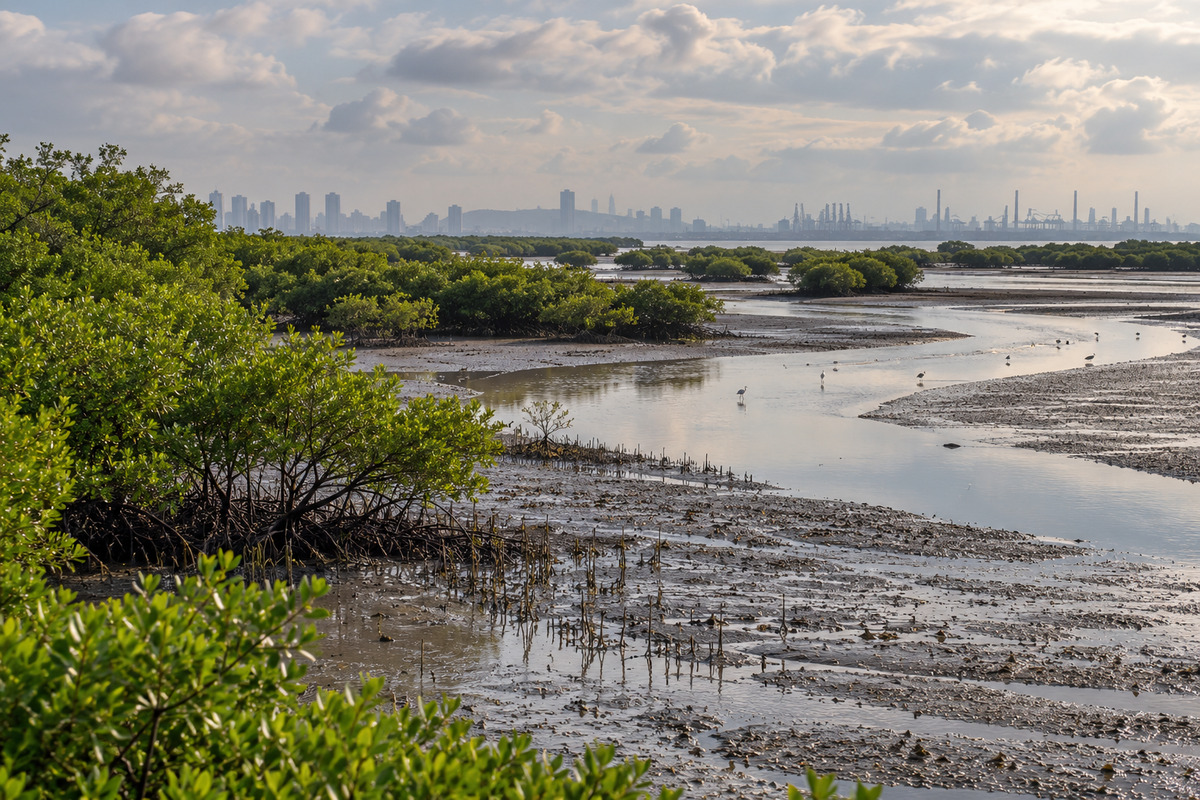
Construction methods included drilling intended to minimise disturbance to nearby flamingo colonies and a temporary access bridge used to avoid disrupting important mudflats. More than 6,000 fisherfolk whose livelihoods were affected by the project received compensation, according to Sunil Annasaheb Wandhekar, MMRDA’s engineer-in-chief. Wandhekar also highlighted lightweight steel construction and anti-corrosion coatings in his April 2024 JICA Magazine assessment of the harbour crossing.
Wandhekar expected improved access to education, health care and jobs on both sides of the harbour, and forecast further industrial and property development around Navi Mumbai. He highlighted connections to the Mumbai–Pune Expressway, Mumbai–Pune Road, Mumbai–Goa Highway and Virar–Alibaug Multi-Modal Corridor. His travel-time description referred to an hour between city centres falling to around 30 minutes, with about 15 minutes for the Sewri–Chirle crossing at peak times. These route-specific figures accompany his April assessment, rather than measuring employment or property growth after construction.
Monitoring after the opening
Ultra Tech Environmental Consultancy and Laboratory carried out ambient-air testing for the MTHL Package 1 project using samples taken on December 9–10, 2024. The laboratory sampled near the STP casting yard and near MP-01, at a height of one metre over a 24-hour sampling period. The two locations had separate laboratory reports, subsequently disclosed by JICA in the project’s environmental-testing annex. Each test was associated with its own location code and sample record.
Reported PM10 concentrations were 95 and 96 micrograms per cubic metre at the two locations. PM2.5 values were 36 and 37 micrograms per cubic metre. The tables show comparison values of 100 for PM10 and 60 for PM2.5 under the listed national ambient-air standard. The laboratory limits its results to the samples tested. These dated, location-specific observations therefore remain individual monitoring results: they do not establish an annual average, a before-and-after trend, or the bridge’s causal effect on air quality across Mumbai Bay.
A later inspection programme
On July 21, 2026, JFE Engineering announced an inspection contract for the orthotropic steel deck box-girder section with NEXCO East and Chodai, working through JFEE Infra Private Limited. The inspection section covered approximately eight kilometres of orthotropic steel deck box girders. MMRDA was the client, Gawar Construction the prime contractor and the contract duration 36 months. JFE had earlier designed, fabricated and transported Package 2 steel girders under a 2018 contract with the Daewoo–Tata joint venture, completing that scope in November 2021.

The inspection work would draw on JFE’s design and fabrication experience, NEXCO East’s steel-bridge inspection expertise and Chodai’s maintenance capabilities. The partners also aimed to transfer technology to the Indian subsidiary so that it could conduct inspections independently in future. JFE and NEXCO East had participated in a government-commissioned overseas infrastructure operation and maintenance study in fiscal 2023. A September 2025 road-technology seminar and proposals to MMRDA preceded the contract. The agreement covered subsequent inspection work and capability development; it did not announce completion of the 36-month programme.






Leave a comment