
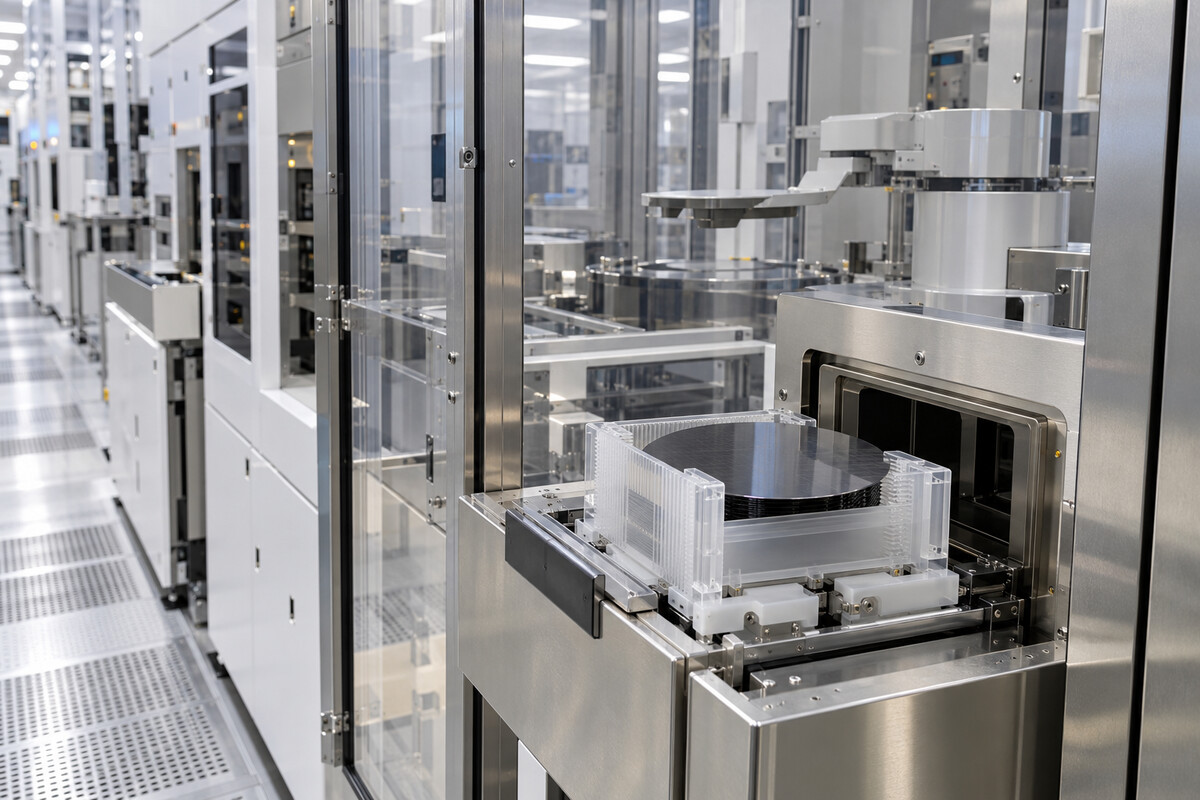
Bosch had begun sample production at its semiconductor factory in Roseville, California, by July 13, 2026, when it announced a $225 million agreement with the U.S. Department of Commerce. The converted plant will manufacture silicon-carbide power semiconductors. Commercial production remained scheduled for later in 2026 when the company announced the milestone. Paul Thomas, Bosch’s North American president and chief executive, linked the investment to customers seeking reliable supplies closer to their own operations.
Thomas also identified the U.S.-Mexico-Canada Agreement as one reason for expanding Bosch’s semiconductor investment in the United States. These chips manage high-voltage electricity, including the flow of energy between an electric vehicle’s battery and motor. Their potential applications extend to data centers, hybrids and defense, Thomas told Reuters. Bosch also planned up to $7.5 billion of investment across its U.S. operations through 2031. That broader spending program covered the company’s operations beyond the Roseville semiconductor project.
A silicon foundry becomes a silicon-carbide project
The Roseville location had operated since 1984 when Bosch announced its acquisition plan on April 26, 2023. Its owner, TSI Semiconductors, employed around 250 people and operated as a foundry for application-specific integrated circuits. TSI developed and produced chips on 200-millimeter silicon wafers for mobility, telecommunications, energy and life-science applications. Bosch proposed converting this existing manufacturing operation to silicon carbide, retaining a location with established cleanrooms and semiconductor expertise while changing the material and manufacturing processes used inside it.
The initial conversion plan envisaged more than $1.5 billion of investment over several years and approximately 10,000 square meters of cleanroom space. Its full scope depended heavily on federal funding and California economic-development opportunities. Bosch and TSI did not disclose the transaction’s financial terms. The announced investment therefore described the planned redevelopment of the manufacturing site. Bosch’s 2023 timetable put the first 200-millimeter SiC chips in 2026, following a retooling period. At the announcement stage, the acquisition agreement itself still required regulatory approval.
Closing the acquisition and organizing the conversion
Bosch completed its acquisition of TSI’s assets on August 31, 2023, and named the new organization Robert Bosch Semiconductor LLC. Approximately 250 local employees joined Bosch. Thorsten Scheer became plant manager and regional president of Bosch’s Automotive Electronics division in North America. His responsibilities included integrating Roseville into the company’s international semiconductor network and managing its transformation into a silicon-carbide production facility. Scheer brought experience in the sensor business, leadership assignments in several countries and work on post-merger integration. A physicist with a doctorate in economics, he had held Bosch leadership positions in Hungary and Germany.
Bosch also had approval for a $25 million California Competes Tax Credit from the Governor’s Office of Business and Economic Development. The incentive would support redevelopment and investment in Roseville. Bosch intended to seek federal support under the CHIPS and Science Act. The scope of its planned manufacturing investment depended on federal funding opportunities, and production was to build up gradually. Roseville combined its existing workforce’s expertise with Bosch’s semiconductor network elsewhere. In September 2023, Bosch still scheduled the first 200-millimeter SiC chips for 2026.

The end of an earlier foundry service
The change in manufacturing direction also affected an existing customer of TSI’s engineering services. Atomera had worked with TSI Technology Development & Commercialization Services under research-and-development and manufacturing agreements from April 2016 through January 2024. Those arrangements supplied foundry engineering and manufacturing services for part of Atomera’s internal research. In October 2023, Bosch informed Atomera that it would stop providing these services to third parties on January 31, 2024, as the fab began its conversion to silicon-carbide semiconductor products.
Atomera described the interruption in its annual report for 2024, filed in March 2025. Some internal projects required complete semiconductor-device fabrication, and replacing the foundry meant adapting research processes to another provider. Atomera said few foundries offered comparable research-and-development services. It warned that the transition could increase startup costs and divert engineering resources. It also stated that no wafers sold or licensed to customers had been fabricated at TSI, and it did not expect a meaningful effect on ongoing customer engagements. The company nevertheless identified potential consequences for the timing and cost of developing future example applications and devices.
From proposed support to a defined manufacturing scope
On December 13, 2024, Bosch and the Commerce Department signed a nonbinding preliminary memorandum of terms for up to $225 million in proposed CHIPS funding. The planned Roseville factory would perform both front-end device manufacturing and back-end operations. Its back-end scope included testing, sorting and dicing. Bosch expected the facility’s first chips on 200-millimeter wafers in 2026. Funding remained at the preliminary stage, and assistance was proposed for the future manufacturing program.

The proposal also contained workforce commitments. Construction was to operate under a project labor agreement with the Sacramento-Sierra Building and Construction Trades Council. The project was expected to create up to 1,000 construction jobs and up to 700 manufacturing, engineering and research positions. These were projections associated with the proposed expansion. Bosch committed to helping employees and construction workers find affordable, high-quality child care through a navigation tool.
What Bosch had installed by the sample-production milestone
In July 2026, Bosch announced a definitive agreement for up to $225 million in direct Commerce Department funding to support up to $2 billion of investment in Roseville. The company had developed new cleanroom space and a manufacturing line for silicon-carbide chips. It had maintained employment of the existing associates during the transformation and invested in training and collaboration across its production network. The site then employed more than 300 associates, with further growth dependent on market development.
Bosch planned to manufacture commercial chips on 200-millimeter wafers during 2026 and, subsequently, third-generation SiC devices in Roseville. The Bosch Community Fund had provided $200,000 in grants to schools and nonprofits in the area since 2024, reaching nearly 1,500 students and teachers. Beginning in 2026, the company planned community-fund investment exceeding $100,000 annually. These grants supported educational resources, certification expenses, tools and other training needs as the manufacturing operation advanced toward commercial output.

Training technicians before the production ramp
Sierra College awarded certificates of achievement to ten Bosch associates on February 12, 2025. They had completed a customized mechatronics program developed by the college and Bosch to prepare workers for the Roseville plant’s new equipment. The standard program usually took between 18 and 24 months. The customized version condensed it into one year through summer classes and additional laboratory space. The college designed the program within two months, using the period before SiC production to give existing employees additional technical skills.
Mechatronics brings together subjects needed to operate and maintain industrial systems. Sierra’s program includes robotics and industrial automation, with study covering electronics, mechanical systems and programming. Its educational options include associate degrees, a certificate of achievement and a skills certificate. Bosch also supported the college foundation’s Career Technical Education Support Fund with a $100,000 grant. Eligible educational expenses included certification fees, protective equipment, software, microcontroller kits, tools and resources for technical clubs and competitions. The college identified related occupations including:
- industrial electricians and field-service technicians;
- programmers working with programmable logic controllers;
- microcontroller programmers.
The manufacturing experience behind the new site
Bosch’s SiC manufacturing work in Reutlingen, Germany, preceded the Roseville acquisition. During early 2021, it produced chips for customer validation using processes developed in-house. In December 2021, the company announced the start of volume production for automotive manufacturers. That sequence separated initial validation samples from the later manufacturing ramp. Bosch was already working on a second generation and expanding cleanroom space as it prepared to supply more customers. Its production-capacity ambitions at the time extended into the hundreds of millions of devices.

The 2021 expansion added about 1,000 square meters of cleanroom space in Reutlingen, with another 3,000 square meters planned by the end of 2023. Bosch also intended to move from six-inch to eight-inch wafers. Producing chips required a wafer to pass through hundreds of manufacturing steps over several months. Larger wafers would let more chips undergo those steps in each production run. Bosch intended to make this wafer-format change in the future, alongside the addition of equipment to existing cleanroom areas and continued development of its proprietary processes.
Cleanrooms also require power and process infrastructure
In February 2022, Bosch announced a further Reutlingen expansion costing more than €250 million, with new production space intended to enter operation in 2025. The project included an extension providing approximately 3,600 square meters of cleanroom space. It also called for an expanded power-supply facility and another building for media-supply systems serving the new and existing production areas. Bosch planned this infrastructure to support both the additional manufacturing space and production already operating at the site.
Bosch then used 150- and 200-millimeter technology in Reutlingen, while its Dresden plant manufactured on 300-millimeter wafers. Both locations used data-driven process control, including software for automated defect classification and artificial-intelligence methods to improve material flows. The Reutlingen extension was intended to support demand for MEMS sensors and SiC power semiconductors. Its budget supplemented earlier cleanroom investments and a separate global semiconductor-spending program. Bosch had also earmarked €150 million for cleanroom additions within existing Reutlingen buildings during 2021–2023. Those announced projects concerned different facilities and equipment programs within the manufacturing network that Roseville would later join.

Why the material changes the production task
Silicon-carbide devices serve several functions in an electric vehicle. They can be used in the traction inverter, which supplies the motor, in DC/DC conversion and in the onboard charger. SiC’s high breakdown-field strength supports high-voltage operation with low on-state resistance. Automotive electronics also face temperature fluctuations and long service lives. Bosch product manager Anne Bedacht emphasized those operating demands in October 2024 when explaining the company’s device development and its adaptation of trench-etching technology. The resulting component designs must accommodate the electrical conditions and service demands of automotive applications.
Manufacturing the material brings additional work. SiC crystal growth requires temperatures around 3,600 degrees Fahrenheit, followed by more than 300 processing steps across over ten mask or structural levels before the material becomes a chip. SiC components also cost more than comparable silicon components. Bedacht distinguished common silicon-based inverter modules in smaller, 400-volt vehicles from applications using 800-volt architectures, where SiC’s benefits were more pronounced. Bosch offered the technology as individual chips and packaged devices, while also incorporating it into modules and complete automotive systems.
Wafer quality and the transistor structure
SiC MOSFETs have two principal structures: planar and trench. A planar device places its gate structure at the surface; a trench device incorporates it vertically within the material. Bosch developed a dual-channel trench design using an electron channel on each side of a trench. Its design shields the gate oxide from high electric fields, while controlled oxide processing supports reliability. Short-circuit withstand time must cover fault detection, the gate driver’s response and the time required to switch off. Bosch also sought low threshold-voltage drift to stabilize conduction and switching behavior. Bosch’s technology combines transistor performance with the robustness required for automotive use.

Crystal defects in substrates can affect device yield and electrical reliability when production moves to larger wafers. Bosch used characterization methods including X-ray topography, optical inspection and ultraviolet photoluminescence to assess substrates and epitaxial layers. The company maintained multiple substrate suppliers and, since 2024, used laser splitting for some thin 200-millimeter substrates in Reutlingen. Material analysis accompanied comparisons of electrical parameters between devices made on 150- and 200-millimeter wafers. Bosch compared leakage-current distributions, breakdown voltages and switching behavior for identical transistor designs manufactured on the two wafer sizes.
Device generations and the next manufacturing steps
In April 2026, Bosch began introducing its third-generation SiC chips and supplying samples to global automakers. The company described performance up to 20 percent higher than the previous generation, together with smaller devices. It attributed the improvement to manufacturing expertise that included an adaptation of its etching process, originally developed for sensors in 1994. This process allowed high-precision vertical structures in silicon carbide. Bosch linked miniaturization to the ability to manufacture more chips from each wafer, improving cost efficiency as well as the power density of the devices.
By that announcement, Bosch said it had delivered more than 60 million SiC chips worldwide since first-generation production began in 2021. Its Reutlingen fab was developing and manufacturing third-generation devices on 200-millimeter wafers. The company intended to supply SiC chips from both Reutlingen and Roseville and, over the medium term, expand production into a unit volume in the mid-nine-figure range. These were company manufacturing plans. Roseville had reached sample production by July 2026 within that broader program. Commercial manufacturing and the subsequent device-generation rollout remained scheduled next steps.














Leave a comment