
A transport test with 92 antiprotons
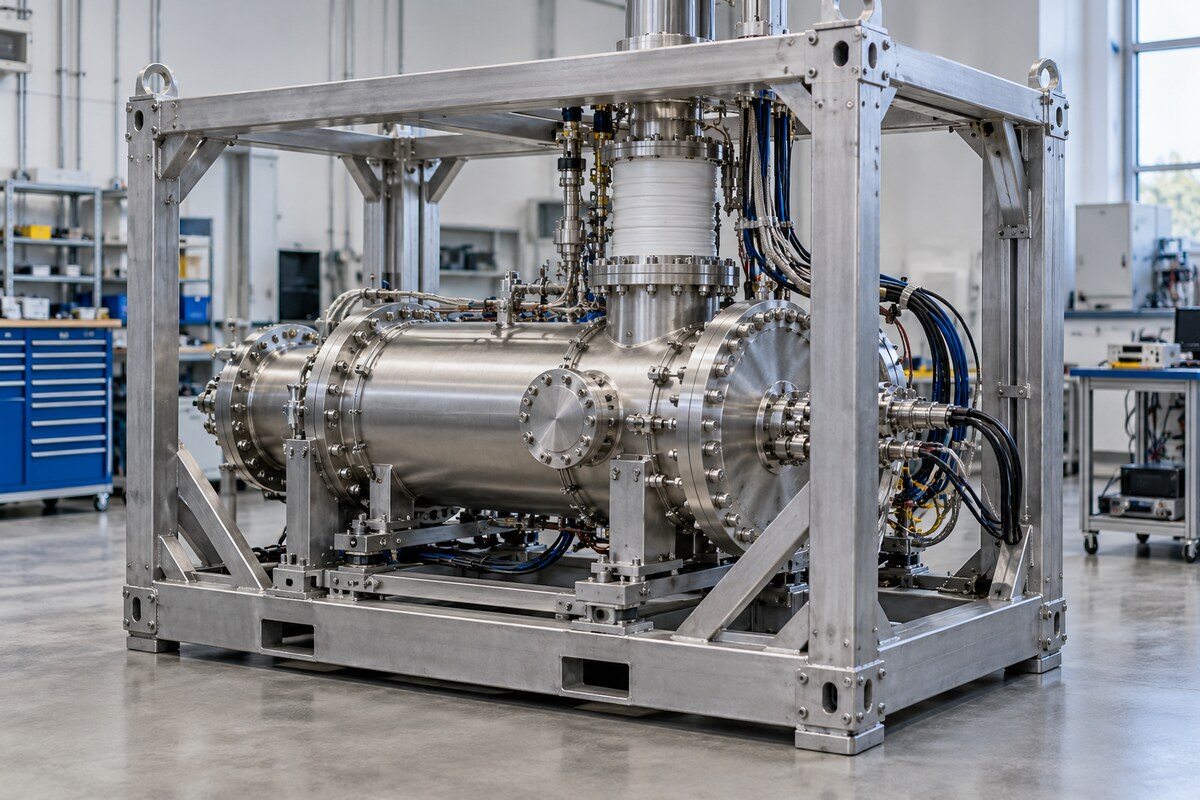
CERN’s Baryon Antibaryon Symmetry Experiment (BASE) team transported 92 antiprotons by truck across the laboratory’s main site on March 24, 2026. The particles remained confined in a portable cryogenic Penning trap, and the team continued operating the experiment after the journey. CERN described the on-site journey as the first transport of trapped antiprotons by truck.
BASE spokesperson Stefan Ulmer identified magnetic-field fluctuations from nearby accelerator equipment as a limit on precision measurements. Moving antiprotons to quieter laboratories would allow researchers to compare their properties with those of protons under different experimental conditions.
BASE-STEP leader Christian Smorra put the journey to Heinrich Heine University Düsseldorf in Germany at at least eight hours. Longer-distance delivery remained an objective after the successful on-site test. The team was investigating a truck-mounted generator and cryocooler, with transfer into another experiment still a major challenge.

A trap that can receive, store and release
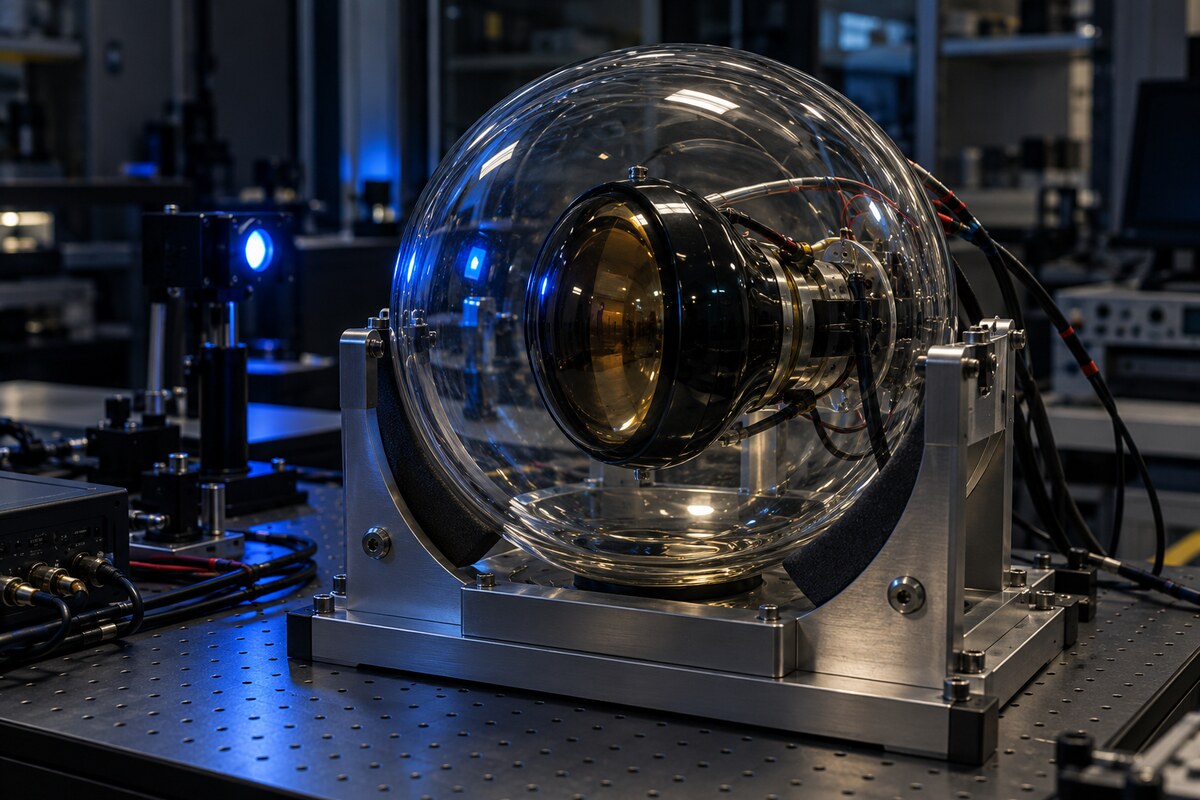
The portable-trap concept already separated particle handling from long-term storage in 2021. Its planned Penning-trap system occupied the bore of a superconducting magnet and combined electric and magnetic fields to confine charged particles. A liquid-helium cooling system was intended to support several hours of transport without electrical power for cooling. The magnet also had to withstand forces associated with moving the apparatus.
Two vacuum chambers contained separate electrode stacks. One formed a vacuum-lock trap for receiving and releasing particles. The other formed a reservoir trap, where antiprotons could remain stored. A turnable electrode blocked the direct path between the injection port and reservoir, shielding the stored particles from residual gas entering through the port. The arrangement provided distinct locations for transfer and protected storage inside the portable apparatus.
The proposed device measured 1.9 metres long, 0.8 metres wide and 1.6 metres high, with a maximum mass of 1,000 kilograms. Those were design dimensions during development, when completion in 2021 still depended on decisions and approvals. Smorra led the project with a European Research Council Starting Grant.

The rehearsal used ordinary protons
On October 24, 2024, BASE-STEP carried a cloud of 70 unbound protons around CERN’s main site. The ordinary-matter particles were stand-ins for a later antiproton journey. The reusable trap retained them through loading and road transport, with monitoring continuing during the trial. Smorra identified a better vacuum as a requirement for moving from protons to antiprotons. The rehearsal tested a transportable confinement system rather than delivery of antimatter to a distant laboratory.
The apparatus weighed 1,000 kilograms and required two cranes to move it from the experimental hall onto the truck. Its footprint was five times smaller than that of the original BASE experiment, and its width allowed passage through ordinary laboratory doors. Liquid helium kept the superconducting magnet below its maximum operating temperature of 8.2 kelvin. Smorra highlighted journey duration and possible traffic delays as constraints on the helium supply. A power generator for longer journeys remained under investigation, alongside refinements to the transport procedure and resistance to road vibration.
Reservoirs and precision measurements
BASE received approval in 2013 and used multiple Penning traps to compare properties of matter and antimatter. In a 2015 measurement campaign, the collaboration made approximately 13,000 comparisons over 35 days. A single antiproton was compared with a negatively charged hydrogen ion, consisting of a hydrogen atom with an additional electron. The ion served as a proton proxy. The measurement used the particles’ cyclotron frequencies, which depend on their charge-to-mass ratios in a magnetic field.

A reservoir retained a cloud of several hundred particles for later use, while a pair entered the measurement arrangement. Parking electrodes allowed one particle to wait upstream or downstream while the other occupied the measurement trap. Repeating this exchange thousands of times provided the comparisons. The magnitudes of the proton and antiproton charge-to-mass ratios agreed within 69 parts per thousand billion. The comparison tested charge-parity-time symmetry, or CPT: a difference in the magnitudes of these ratios would challenge that symmetry. No such difference was established by the campaign.
Measuring a very small magnetic moment
By January 2017, BASE had compared proton and antiproton magnetic moments within an experimental uncertainty of 0.8 parts per million. Their magnitudes agreed, with opposite signs. The result improved precision sixfold over the ATRAP collaboration’s 2013 measurement. A magnetic moment characterises how a particle behaves in a magnetic field. For protons and antiprotons, CPT symmetry predicts equal magnitudes with reversed signs, making the comparison another test of their fundamental properties.
The experiment cooled antiprotons to approximately one degree above absolute zero before feeding them individually into further traps. Their magnetic moments are much weaker than those of electrons and positrons, whose properties had already been studied using related methods. BASE therefore required a specially designed magnetic bottle more than 1,000 times stronger than those used in electron–positron experiments. Further trapping developments were expected to improve precision into the parts-per-billion range, but that remained the next measurement objective.
Two particles in separate traps
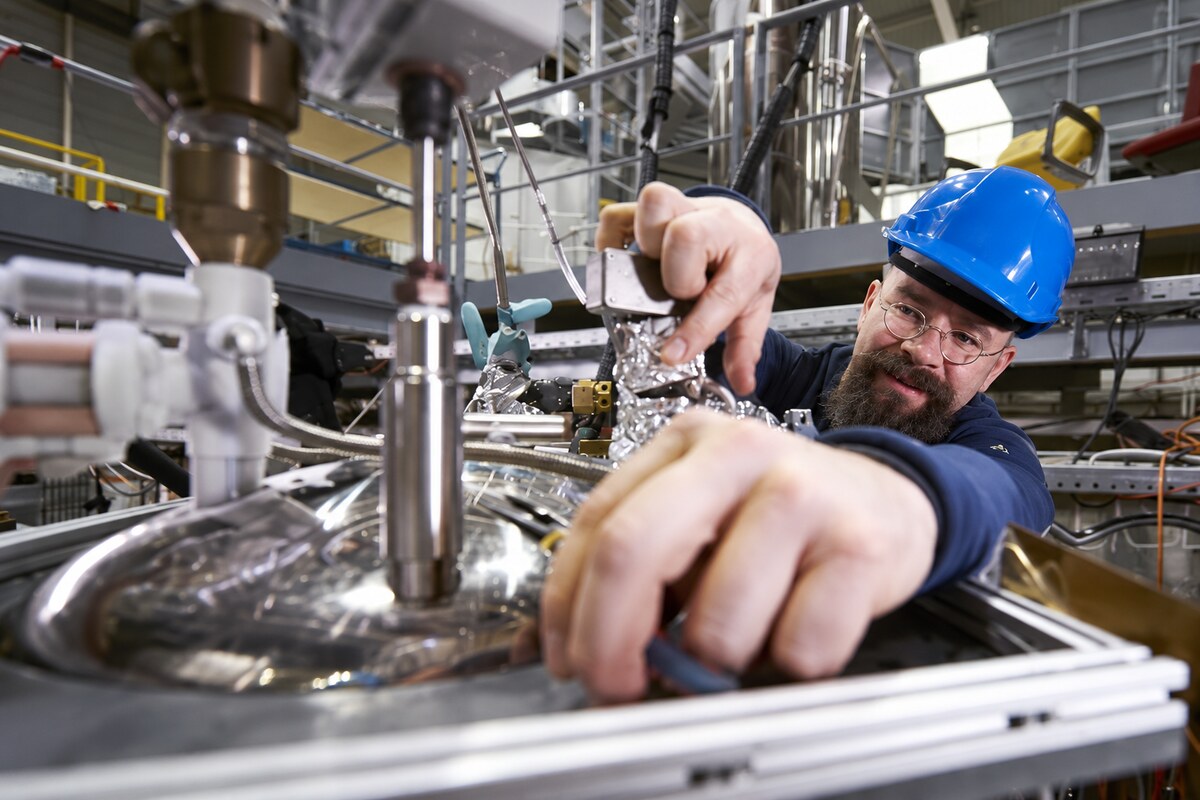
In October 2017, a new BASE method used simultaneous measurements on two antiprotons confined in separate Penning traps. The collaboration improved the precision of its earlier magnetic-moment measurement by a factor of 350. The resulting antiproton measurement had a smaller experimental uncertainty than the proton value available for comparison. Ulmer described the achievement as the result of sustained research and development of Penning-trap instrumentation.
The proton comparison had been measured in 2014 at BASE’s companion experiment in Mainz. The new antiproton result remained consistent with equal magnitudes of proton and antiproton magnetic moments within experimental uncertainty. Smorra, the study’s first author, highlighted the unusual situation in which an antimatter property had been measured more precisely than its matter counterpart. The two-trap method was a precision-measurement development; it did not itself constitute transport of trapped particles outside CERN.
Measurements during quieter accelerator periods
A later BASE comparison used four measurement campaigns between December 2017 and May 2019. More than 24,000 cyclotron-frequency comparisons, each lasting 260 seconds, alternated antiprotons with negatively charged hydrogen ions under the same conditions. Correcting for the difference between a hydrogen ion and a proton allowed the team to compare proton and antiproton charge-to-mass ratio magnitudes. The January 2022 result found agreement within an experimental uncertainty of 16 parts per trillion.

The collaboration carried out measurements while CERN’s antimatter factory was shut down, drawing on antiprotons already held in its reservoir. Without accelerator operation, magnetic disturbances affecting the frequency measurements were reduced. The same programme also examined possible differences in the gravitational interaction of protons and antiprotons as Earth moved around the Sun. It found no difference at the achieved sensitivity and set a differential limit of three parts in 100. This was an indirect test based on cyclotron frequencies, rather than an experiment dropping antimatter and directly observing its fall.
Cooling through a separate ion cloud
In 2021, BASE demonstrated another approach to preparing particles for precision measurements at the University of Mainz. A single proton occupied one Penning trap, while a laser-cooled cloud of beryllium ions occupied another. A superconducting resonant electric circuit coupled their oscillations. Energy passed from the proton to the colder ion cloud, reducing the proton’s motion without putting both species into the same trap. The demonstration involved a proton, with antiproton applications still to follow.
Smorra anticipated that optimised procedures could reach temperatures of approximately 20–50 millikelvin, ideally in cooling times around ten seconds. Earlier methods had reached 100 millikelvin over ten hours. Those faster times and lower temperatures were development targets, not a claim that transported antiprotons had already achieved them. Separating the two traps addressed the difficulty of combining matter and antimatter in a single confinement device. Ulmer linked the technique to the collaboration’s longer-term aim of improving comparisons of fundamental antimatter constants to sensitivities below one part per trillion.

Faster preparation for spin measurements
In August 2024, BASE introduced a device that reduced overall antiproton cooling time from 15 hours to eight minutes. Measuring spin transitions required particles colder than 200 millikelvin. The system extracted individual antiprotons from a stored population and moved them between a temperature-measurement trap and a cooling trap until the required temperature was reached. The experiment needed approximately 1,000 measurement cycles, making preparation time an important part of the measurement programme.
The cooling trap’s diameter was reduced to 3.8 millimetres. Segmented electrodes suppressed the cyclotron mode of motion more effectively, while improved readout electronics reduced background disturbances that heated the particle. Time spent inside the cooling trap during each cycle fell from ten minutes to five seconds. Separate changes reduced measurement time fourfold. These were different stages of preparation and readout, alongside the eight-minute overall cooling figure. Lead researcher Barbara Latacz described the resulting prospect of completing the required measurements in less than a month instead of several years of continuous operation.
Maintaining a coherent antiproton spin
In July 2025, BASE maintained coherent transitions between an antiproton’s two spin states for 50 seconds. The collaboration used electromagnetic traps to control the transitions, demonstrating an antimatter quantum bit. Earlier magnetic-moment comparisons had relied on incoherent spectroscopy, affected by magnetic-field fluctuations and interference from measurements. Suppressing these disturbances enabled the team to follow controlled spin evolution for a much longer period within its experimental system.

Coherent spectroscopy offered new methods for comparing the magnetic moments of protons and antiprotons. Ulmer anticipated future measurements with precision improved by factors of ten to 100. Latacz also suggested that a fully operational offline Penning-trap system, supplied with particles by BASE-STEP, could extend spin-coherence times further. These were expectations for subsequent experiments. The single-antiproton qubit was a tool for fundamental physics, with no immediate applications outside that field anticipated. Its role was to help researchers control and measure an antimatter particle, rather than to demonstrate a practical quantum computer or an observed violation of CPT symmetry.
Producing the low-energy beam
The Extra Low Energy Antiproton ring, ELENA, supplies the particles used by several CERN experiments in Geneva, Switzerland. The 30.4-metre-circumference synchrotron decelerates antiprotons from the Antiproton Decelerator’s kinetic energy of 5.3 MeV to 100 keV. Electron cooling reduces beam emittance during the deceleration sequence. The ring can prepare four bunches for distribution to different experiments, connecting the particle source with several experimental programmes at the same time.
Commissioning began with negatively charged hydrogen ions in November 2016. Antiprotons first circulated in August 2017, and beams reached 100 keV in May 2018. The GBAR experiment received a beam later that year. A local ion source subsequently allowed commissioning work to continue while antiprotons were unavailable during CERN’s 2019–2020 shutdown.

Physics delivery to the connected experiments began on August 23, 2021. An automatic Beam Request Server handled requests and shared the available bunches among users. In the first physics run, ring transmission reached approximately 80%, compared with a 60% design value. This measured transmission concerned passage through ELENA, distinct from an experiment’s eventual particle-trapping efficiency.
Electrostatic transport within the facility
ELENA’s extraction network used approximately 125 metres of beamlines and 239 electrostatic elements. Low particle energy allowed electric fields to steer and focus the beam. The equipment included fast deflectors, fixed-field deflectors for sharper turns, and quadrupole assemblies with dipole correctors. These fixed beamlines delivered particles between the ring and experimental areas, a different transport system from BASE-STEP’s movable trap.
Commissioning used negatively charged hydrogen ions and 38 micro-wire beam-profile monitors. Each monitor had perpendicular grids for measuring both planes. Scans identified broken or unreliable wires so they could be excluded from analysis. Quadrupole scans and beam models then characterised the optics along the lines and at experimental handover points.
Magnetic fields from nearby experiments also affected beam trajectories. On November 3, 2021, powering AEgIS solenoids distorted the neighbouring line serving ALPHA. Iterative steering corrections restored full beam transmission. The commissioning team compared measurements with a model of the stray magnetic fields, addressing the interaction between experimental magnets and low-energy beam delivery.
Access for additional experiments
CERN commissioned TELMAX, a test beamline open to visiting experiments, in 2024. It expanded access beyond the facility’s seven permanent experimental beamlines. A line from ELENA had become available after the ATRAP experiment closed in 2018, providing an opportunity to establish the test beam. Researchers could request antiproton beams for periods of weeks or months, with proposals assessed by the AD/ELENA physics coordinators. The first TELMAX experiment, PAX, received antiprotons on May 5, 2025.
PAX, led by a team from France’s Centre national de la recherche scientifique, was designed to study antiprotonic atoms to test quantum electrodynamics in intense electric fields. The experiment began in September 2024 and was scheduled to work at TELMAX until July 2025, before another experiment took its place. Preparing its beam required an intensity reduction by a factor of 1,000. The delivery system therefore supported several distinct activities:
- Supplying permanent experiments through dedicated transfer lines.
- Adapting beam intensity to a visiting experiment.
- Providing a test area for additional research proposals.

















Leave a comment