
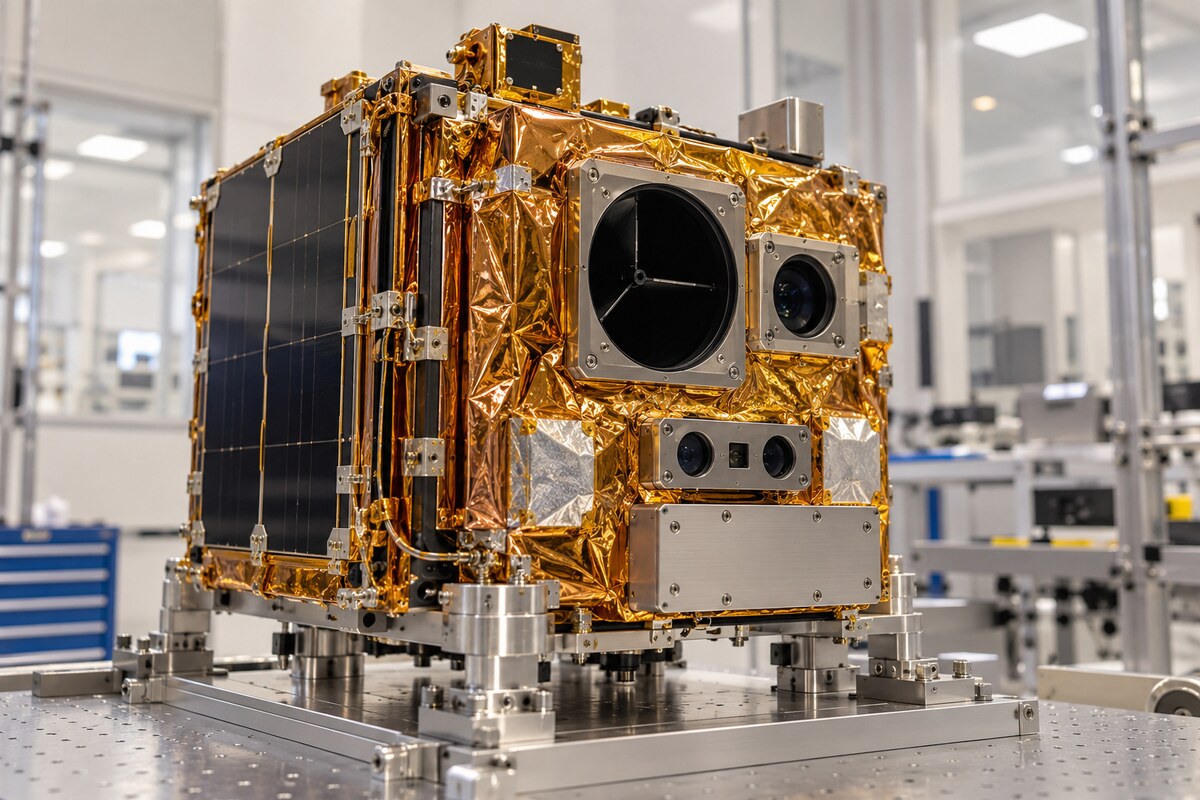
A launch for a close-up investigation
Hera left Cape Canaveral, Florida, on Oct 7, 2024, aboard a SpaceX Falcon 9. The European Space Agency mission will investigate Dimorphos after NASA's DART spacecraft changed the small asteroid's orbit around Didymos. The launch followed weather concerns as Hurricane Milton approached Florida and a flight-authorisation decision after a previous Falcon 9 upper-stage malfunction.
The four-year project involved 18 European countries, about 70 companies and JAXA. Hera project manager Ian Carnelli described it as an international planetary-defence effort. The launch plan called for a two-year journey, arrival in October 2026, a Mars flyby and deployment of two small companion spacecraft at the asteroid system. Hera's measurements are intended to improve understanding of the kinetic-impact deflection technique.
Building the main spacecraft in two parts
Hera's core and propulsion modules were joined at OHB in Bremen, Germany, in August 2023. Separate modules allowed work on the spacecraft's systems to proceed in parallel before the October 2024 launch window. The propulsion module contains the tanks, piping and thrusters, arranged around a central carbon-fibre-reinforced polymer cylinder. That cylinder forms the spacecraft's structural backbone. The core module carries the onboard computer, mission systems and instruments. During construction, the propulsion module went to Avio near Rome for installation of its propulsion equipment while the core remained at OHB.

Joining the modules took about three hours. Alignment cages held their relative positions to within a few tenths of a millimetre as a crane lowered the core module onto the propulsion section. Engineers simulated the operation in computer-aided design software beforehand and continued checking alignment during the lift. An initial test bolt confirmed the fit before the modules were fully secured together. Side panels retained access to internal equipment after assembly.
Reproducing the launch environment
Hera completed acoustic testing in November 2023 inside the Large European Acoustic Facility at ESTEC in the Netherlands. Its quartet of horns can generate more than 154 decibels; the spacecraft's actual test used a noise profile supplied by its launch provider. Nitrogen flowing through the horns produces the sound. Reinforced concrete walls contain it, an epoxy coating helps distribute the acoustic field, and rubber bearing pads isolate the chamber from neighbouring facilities. A door interlock prevents operation while the chamber is open.
The spacecraft was powered during the tests, with its solar wings folded in launch configuration. Helium, nitrogen and water filled the tanks for testing. More than 130 accelerometers measured the mechanical response, while surrounding microphones checked the sound levels. Each acoustic session lasted one minute. Earlier shaker-table tests had addressed vibration loads. Functional checks followed the mechanical campaign, with sustained operation in vacuum and temperature extremes planned as the next major qualification stage. The tests covered the assembled spacecraft and its installed components.

Deployers that support a long journey
Hera's two Deep Space Deployers support their CubeSats throughout the cruise as well as releasing them at the destination. ISISPACE designed them for release speeds of only a few centimetres per second. The intended sequence first raises a CubeSat towards the top of its deployer while keeping an umbilical connection for power and communications. About 24 hours of exposed-space checks follow before final separation. The mechanism must also limit unwanted rotation, which would otherwise require the small spacecraft to spend cold-gas propellant correcting it.
A Life Support Interface Board connects each deployer and CubeSat to Hera. It converts electrical signals and supply voltages and isolates faults that could affect the main spacecraft. Kuva Space developed the boards, with product assurance from the Finnish Meteorological Institute. Ground validation of the gentle release used a pendulum rig and high-speed cameras. A failure during vibration qualification led to stronger actuation springs and changes to reduce friction. The deployers had been accepted, delivered and integrated by June 2023; integrated CubeSat testing remained a subsequent step.
Adapting hyperspectral imaging for an asteroid
HyperScout H is a shoebox-sized hyperspectral imager developed by cosine Remote Sensing. Its measurements are intended to identify variations in the asteroid's mineral composition and help characterise material exposed or redistributed by DART's impact. The flight unit passed a formal inspection point in April 2023 at cosine's cleanroom in Sassenheim. ESA and manufacturer specialists inspected the instrument before environmental testing at the agency's Mechanical Systems Laboratory. Those tests would check whether the unit could endure the conditions expected during Hera's mission.

The instrument family already had flight heritage in Earth observation. Earlier versions flew on GomX-4B in 2018 and FSSCAT in 2020, with applications including environmental monitoring. HyperScout H adapted that compact design to an interplanetary mission's environmental and performance requirements. Its asteroid observations will supply mineralogical information alongside the mission's other measurements of structure and surface properties. The development brought together an existing imaging platform, a new target environment and a dedicated flight model. The April inspection preceded the instrument's qualification and integration rather than representing an asteroid observation.
Measuring gravity after a small spacecraft lands
The GRASS gravimeter is designed to measure extremely weak surface gravity after Juventas comes to rest on Dimorphos. Developed by the Royal Observatory of Belgium and EMXYS, the instrument has a mass of 330 grams and requires about half a watt. Two sets of thin blades sit in rotating cradles. Their tiny deflections change the capacitance between the blades and surrounding walls. Continuous rotation and the two perpendicular measurement directions allow the instrument to reconstruct the gravity vector even when the CubeSat's final landing attitude is unknown.
GRASS underwent thermal-vacuum and vibration tests in 2023 before integration into Juventas. Laboratory measurements and numerical simulations assessed its sensitivity; the asteroid's low-gravity operating conditions could not be reproduced directly on Earth. The plan calls for measurements during touchdown, subsequent bounces and the settled surface phase. Because a landed CubeSat's solar panels might be obstructed, GRASS was designed to run from the spacecraft's battery for up to 20 hours. Changes in local gravity during Dimorphos's orbit would provide additional information about the asteroid system.

A radar packed into a CubeSat unit
JuRa, the Juventas radar, was delivered for integration in August 2023. Its electronics package measures about 9.5 centimetres on each side, while four deployable antennas each extend 1.5 metres. Astronika manufactured the antennas, which unfold in a manner similar to metal tape measures. The instrument design was developed by IPAG with the Technical University Dresden; EmTroniX supplied radar electronics and a software-defined-radio signal processor. Components underwent radiation testing before delivery because the charged-particle environment beyond Earth orbit can damage electronic devices.
The radar uses a 60-megahertz signal to probe below the surface. Slow motion near the asteroid allows repeated transmissions of the same coded signal, improving the signal-to-noise ratio despite limited power. The code also helps separate radar returns during processing. The proposed sounding depth of up to 100 metres depends on the material inside Dimorphos: a relatively uniform interior permits different penetration from a fragmented structure with large blocks and voids. JuRa's design draws on radar experience from Rosetta's investigation of comet 67P, adapted to a much smaller spacecraft.
Juventas as an independent spacecraft
The integrated Juventas CubeSat delivered in March 2024 measured 37 × 23 × 10 centimetres. GomSpace oversaw the spacecraft, with integration at its head office. The radar's heat output required particular attention from the thermal-design team within the small spacecraft envelope. Juventas also carries a visible-light camera, lidar, star trackers, a cold-gas propulsion system and an inter-satellite radio link. These systems support navigation around the asteroids and return measurements through Hera. Radar data are to be decoded and converted into a three-dimensional picture on Earth.

The planned survey uses a self-stabilised terminator orbit around Didymos. The trajectory follows the day-night boundary and balances the asteroid's weak gravity with solar-radiation pressure. After the radar campaign, Juventas is intended to approach Dimorphos for a landing attempt at centimetres per second. Accelerometers and gyroscopes will record the contact and any bounces. Stable settling would allow GRASS to operate on the surface. These remained planned asteroid operations in the March 2024 delivery account; the spacecraft first had to complete tests with Hera and Milani.
Milani's mineral and dust instruments
Milani, developed by Tyvak International, is a 6-unit-XL CubeSat measuring 13 × 24.6 × 36.6 centimetres. Its main instrument, ASPECT, has four channels spanning visible, near-infrared and shortwave-infrared observations. VTT developed the imager from a family of compact instruments previously used on drones and the Aalto-1 satellite. Each channel requires roughly 50 control signals within the miniature payload. ASPECT will investigate mineral differences across the asteroids and individual boulders. A second instrument, VISTA, detects dust using quartz microcrystals whose piezoelectric response changes when particles adhere to them.
VISTA is intended to investigate dust and volatile species around the asteroid system. Milani also has a navigation camera, laser altimeter, star trackers and cold-gas propulsion. Its planned observing path consists of repeated hyperbolic arcs, with thruster manoeuvres maintaining the required distance. The March 2024 plan envisaged starting about ten kilometres away and approaching as close as two kilometres, followed eventually by a landing attempt. Onboard gyroscopes and accelerometers would measure touchdown dynamics. Milani's navigation and propulsion therefore accompany its spectral imaging and dust measurements throughout the proposed close-range campaign.

Teaching navigation systems before departure
Hera's guidance, navigation and control system combines camera imagery, laser-altimeter measurements and inertial-sensor data. In May 2024, GMV tested an onboard-computer replica against camera views of a model asteroid, while OHB used a full-scale avionics test bench. The proximity-navigation modes include detecting the asteroid's outline against space, finding the centre of its illuminated pixels and tracking surface features in successive images. Different modes apply as the distance and visible detail change. At close range, repeated views of boulders and craters provide information about altitude and motion relative to the surface.
The planned hyperbolic arcs require thruster firings every three to four days, at typical relative speeds around 12 centimetres per second. The trajectories are designed to preserve separation even with small manoeuvre errors. An autonomous correction system and collision-risk estimator can command avoidance manoeuvres when needed. Initial navigation is intended to use ground control, with greater autonomy after CubeSat deployment. Some experimental proximity modes were still undergoing validation after the cruise system had been tested on the flight spacecraft. Their qualification schedule extended beyond launch.
Radio links for three moving platforms
Tekever's inter-satellite links exchange data together with measurements of distance and relative speed. The Hera implementation adapted technology qualified for the Proba-3 mission, using revised networking software for three spacecraft. A modest amplifier-power change supported operation at greater separation. The software-defined-radio design permits such changes without replacing the underlying architecture. Its development included radiation screening of commercial components and several redesigns when candidate parts proved unsuitable. Around the asteroids, the links will help each spacecraft establish where its companions are and maintain communication with Hera.

The design supports separations of up to about 30 kilometres. At greater distances, a lower bit rate gives receivers more time to recover the signal. Range-rate and Doppler measurements also contribute to estimating the asteroids' gravitational fields and masses. The three spacecraft share information over the network and determine which received data require action. The compact electronics fit the CubeSats' PC/104 board standard. In the inter-satellite radio design, communications and relative-position measurements are functions of the same system.
Testing the full communications chain
Hera and both CubeSats communicated over their antennas during June 2024 tests in ESTEC's Maxwell chamber. Nine-metre-high metal walls screened external radio interference, while interior foam pyramids absorbed radio waves. ESA's operations team in Darmstadt commanded the spacecraft remotely and received telemetry through Hera's 1.13-metre high-gain antenna. Simultaneously, the CubeSats used their dedicated inter-satellite links. The setup tested actual radio transmissions where other parts of the qualification programme had used cabled commands. It also allowed engineers to compare communications models with the assembled flight hardware.
The high-gain antenna supports the X-band link to Earth; the shorter-range inter-satellite connections use S-band. HPS manufactured the main antenna, while Anywaves supplied the CubeSat-link antennas. The campaign found no appreciable degradation from the links operating together, including the anticipated possibility of coupling between neighbouring antennas. Tests also covered partial extension of the CubeSats from the asteroid deck while they remained attached to Hera. The sequence checked that communications and operations could be verified before committing each small spacecraft to final release.

Training controllers with deliberately inserted faults
The mission-control simulation campaign began in June 2024, bringing flight-control, flight-dynamics and ground-system specialists together with project and manufacturer teams. Simulations officers introduced faults into a software-only Hera so the controllers could practise finding causes and managing consequences. In one early exercise, a Sun sensor produced a lower output than expected. The team considered contamination or an electrical problem and switched to a backup sensor. The simulated spacecraft then developed an unexpected torque, requiring another response while the team continued to account for the earlier restrictions.
These were training scenarios rather than reported defects in the flight spacecraft. Exercises progressed towards increasingly difficult combinations of problems under operational time pressure. The team included experienced controllers from earlier missions and newer recruits. Their preparations covered the period around launch as well as post-launch operations. Hera is the first spacecraft mission developed under ESA's Space Safety programme and its first mission outside the scientific programme to travel beyond Earth orbit. The simulations campaign formed part of the preparation for taking control after launch and conducting the interplanetary cruise.
The first instrument views after launch
Three instruments observed Earth and the Moon on Oct 10–11, 2024, during near-Earth commissioning. The asteroid deck was pointed back towards Earth for the images. Hera's redundant Asteroid Framing Cameras each use a 1020 × 1020-pixel monochrome visible-light sensor. Produced by Jena-Optronik from its ASTROhead design, they serve navigation and science. One early image showed Earth and the Moon from approximately 1.6 million kilometres. The paired, baffle-protected cameras provide redundancy for the mission's principal visible-light imaging function during its later asteroid operations.

TIRI, the Thermal Infrared Imager, observed the pair from about 1.4 million kilometres. Supplied by JAXA and manufactured by Meisei Electric, it inherits technology from Hayabusa2. Its asteroid measurements will map temperature changes and thermal inertia to investigate properties including roughness, particle size and porosity. HyperScout H also returned a false-colour view from around 1.6 million kilometres. Its 650–950-nanometre coverage extends across visible and near-infrared wavelengths. These first instrument images were commissioning observations of Earth and the Moon, preceding the planned asteroid survey.
Checking the CubeSats while still stowed
Juventas was activated on Oct 17, 2024, about four million kilometres from Earth; Milani followed on Oct 24 at about 7.9 million kilometres. Each spacecraft operated for roughly an hour while remaining inside its deployer. The checkouts activated avionics, instruments and inter-satellite links and spun the reaction wheels used for attitude control. The commands passed through a distributed ground setup linking ESA's main operations centre, the CubeSat operations centre at Redu and the manufacturers' control centres. Telemetry was checked in real time across those interfaces.
Both CubeSats maintained a high battery state of charge at deployer temperatures around 5 °C. Their activity warmed temperature sensors during checkout. The stowed commissioning tests verified the spacecraft and command infrastructure before the close-range phase. Free flight, gentle release and landing attempts remained future operations. Hera would continue supporting both small spacecraft during the journey. Subsequent cruise operations were planned at two-month intervals, including:
- routine health and subsystem checks;
- battery conditioning inside the deployers;
- software updates ahead of independent flight.













Leave a comment