
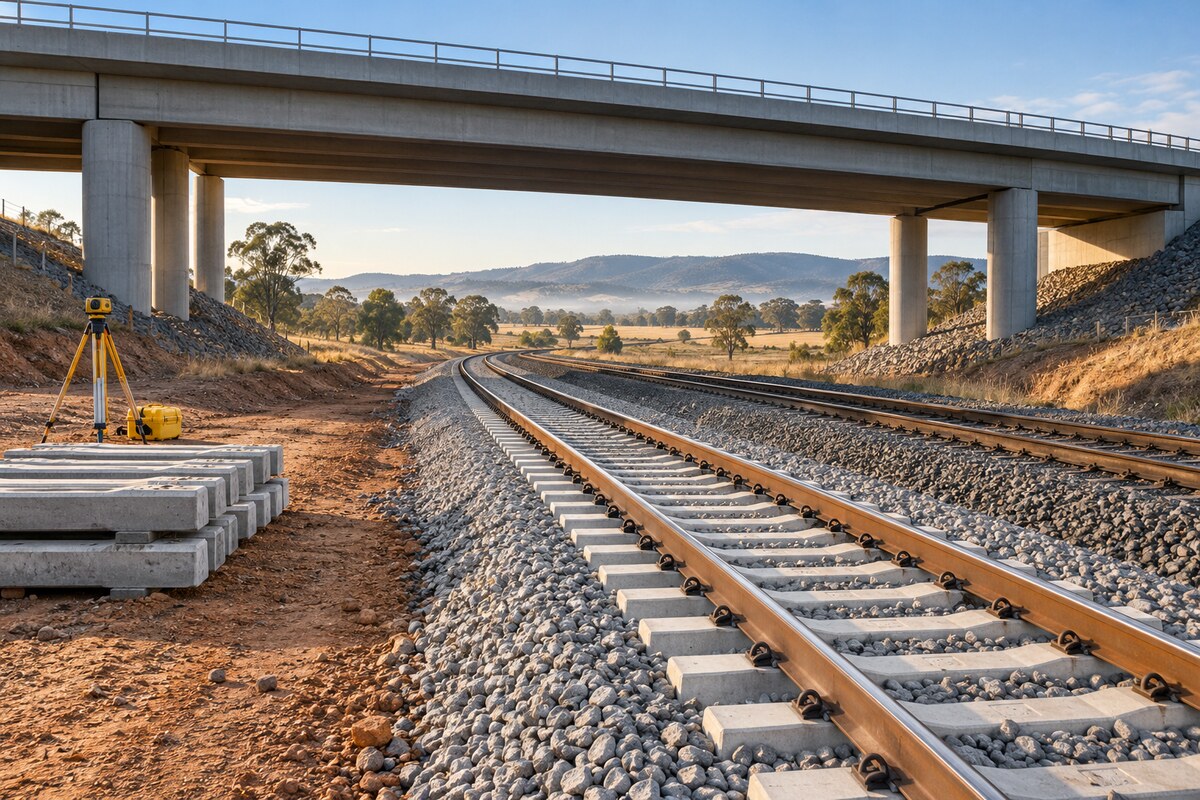
In Australia, the May 2026 withdrawal of funding north of Parkes left Inland Rail’s Melbourne–Brisbane corridor incomplete. Infrastructure Minister Catherine King defended the latest costing and independent assurance. Barnaby Joyce and Parkes mayor Neil Westcott questioned it. Ian Macfarlane of Toowoomba and Surat Basin Enterprise forecast around A$5 billion in lost construction activity, alongside tens of thousands of unrealised jobs. Narromine farmer Katie Cox faced land-acquisition uncertainty despite the halt. The route would split her farm, and land could still be acquired for a future corridor. The funding decision interrupted a route formally set in 2010.
Staging and responsibility
The government had already adopted staged delivery in its April 2023 response to Kerry Schott’s independent review. It accepted nineteen recommendations, either fully or in principle. The response prioritised Beveridge to Parkes, while work farther north would proceed on a least-regrets basis agreed with shareholder ministers. The proposed service offering involved reliable twenty-four-hour transit and double-stacked trains 1,800 metres long. Government support for that offering extended only between Beveridge and Ebenezer. These were service and delivery objectives, rather than a statement that the complete route was operating.

The governance recommendations called for separating construction from the Australian Rail Track Corporation’s existing network business. A subsidiary with a dedicated board and chief executive would concentrate project skills and accountability. The response also supported independent technical scoping and cost estimation, with defined risk-escalation triggers. Other tasks included:
- Checking signalling interoperability with state networks.
- Reviewing construction access during railway possessions.
- Addressing noise and access across regional towns.
- Coordinating terminal development and corridor preservation.
Parkes as an interchange
Parkes already occupied a junction between the proposed north–south corridor and the Trans-Australian Railway. The east–west route connected Sydney with Perth through Port Augusta and the Nullarbor Plain. In November 2024, Inland Rail chief executive Nick Miller and the company’s board visited the 4,800-hectare Parkes Special Activation Precinct. The board then held its first meeting in the town. Miller described Parkes as the project’s flagship location. That description was his assessment of the precinct’s emerging role, alongside its existing position in the national railway network.
The precinct contained the National Logistics Hub, where National Intermodal Corporation was exploring an independently accessible rail terminal. Exploration of that facility did not mean a new terminal had opened. Inland Rail’s contemporaneous local employment figures for the Stockinbingal–Parkes works included 162 residents, twenty-eight of them First Nations people. The company also reported employing fifty-four women and spending more than A$9 million with ninety-seven local businesses. These participation categories could overlap.
A completed southern section
By February 24, 2026, major construction was complete on the 170-kilometre Stockinbingal–Parkes section. It was the third of Inland Rail’s twelve sections ready for double-stacked operations. Construction partner Martinus and Inland Rail had begun works in September 2023. The package combined a new 2.2-kilometre crossing loop at Daroobalgie with changes to structures and track along an existing railway.
At Forbes, crews lowered track beneath the Wyndham Avenue road bridge and modified the Lachlan River bridge to create clearance. Forbes Station and regional rail yards received alignment and clearance improvements. Minor works and maintenance were expected to continue over the following twelve months. Inland Rail reported that twenty-two local businesses had supplied the project. Another participation measure covered seventy-nine businesses from Forbes and Parkes attending supplier-capability workshops through its Skills Academy.
An active road crossing
The Daroobalgie Road crossing had previously relied on passive controls: a stop sign and a notice directing road users to look for trains. Its February 2025 upgrade added high-intensity LED warning lights, bells and reflective boom gates. New signs and line markings accompanied the equipment on the road and railway. The active crossing formed part of the work supporting the nearby passing loop. It provided an approaching-train warning through operating equipment, rather than relying solely on the previous fixed signs.

Inland Rail project director Malcolm Clark, Martinus project director Andy Williams and Forbes Shire Council deputy mayor Chris Roylance attended commissioning. The change responded to the passing-loop project’s safety requirements. Inland Rail expected the active equipment to improve crossing safety and traffic flow, because vehicles would no longer routinely stop when the warning system was inactive. That was the project’s stated expectation, not a published before-and-after collision study.
Stations and clearance works in Victoria
Opening the upgraded Wangaratta station in May 2025 marked completion of the first Victorian construction tranche. Work then shifted to the second tranche, including bridges in Broadford and pedestrian underpasses at Benalla and Euroa. During a fifteen-hour railway possession in October, the new 270-tonne Short Street bridge was lifted into position as a complete structure. Five remaining girders for the Hamilton Street bridge, each weighing approximately forty tonnes, were installed that morning. These were separate lifting operations within one planned interruption to rail services.
Benalla’s station changes began with six precast concrete units forming a pedestrian underpass, followed by tracks above for the new Oaklands line turnout. At Euroa, the Anderson Street bridge was demolished and road detours required 1.7 kilometres of pavement and drainage. The new station underpass involved removing 3,400 tonnes of material, pouring a fifty-nine-square-metre base slab and installing six precast units. A separate replacement at Handbury Street required fifty-two piles. Inland Rail’s December 2025 assessment still targeted completing the Beveridge–Parkes sections in 2027; the individual structures were intermediate construction milestones.

A bridge assembled before installation
The new Broadford–Wandong Road bridge was lifted into place in February 2026. Prefabrication took place in Adelaide, followed by assembly at the worksite. The structure measured thirty-five metres long and 14.5 metres wide, incorporating forty-one main and cross girders. Its approximate mass was 246 tonnes. A mobile crawler crane rated at six hundred tonnes performed the lift.
The higher structure supplied clearance for double-stacked freight trains. Associated road changes included wider lanes and a roundabout at the Rail Street intersection. A shared path, separated from road traffic, would connect pedestrians with surrounding community spaces and gardens. Project director Russell Hamilton identified those connections as intended local benefits. The existing bridge was to remain until the replacement opened to traffic later in 2026, after which demolition would proceed. Installation of the new span, public opening and removal of the old crossing were therefore distinct stages in the planned sequence.
Work inside a railway shutdown
On May 19, 2026, Inland Rail recorded completed works from a ninety-six-hour possession on the Albury–Illabo section. More than seven hundred personnel worked with Martinus across twelve sites in Albury, Wagga Wagga and Junee. Crews excavated over six thousand cubic metres and installed eighty linear metres of culvert segments. The railway returned to service on Wednesday morning.

At the Murray River bridge, new top chords increased the clearance available above trains. In Albury Yard, crews installed under-track signalling routes and moved the main line beneath the Riverina Highway bridge in preparation for subsequent lowering. Ettamogah’s Billy Hughes bridge received its first stage of track lowering. North of Junee, a steel rail bridge was replaced with concrete culverts, with flood performance and greater track separation among the stated purposes. These interventions involved different structures along the operating railway: altering a bridge’s upper members, moving track and replacing a crossing over drainage.
Replacing Edmondson Street bridge
At Wagga Wagga, the Edmondson Street bridge deck was removed during the February 28–March 1, 2026 possession. Two thirty-seven-tonne excavators progressively demolished the deck in three sections. Crews then removed the brick abutments and central brick pier. More than one hundred workers were involved at that site. Across the Albury–Illabo possession, Martinus general manager Gavin Murphy reported 346 people working at eleven sites, consistent with Inland Rail’s rounded description of nearly 350 workers. Rail services resumed on Sunday night after the weekend works.
The replacement design provided two traffic lanes in each direction, an eastern pedestrian footbridge with improved accessibility and a wider western footpath. Those features belonged to the planned new structure. Demolition of the old bridge did not mean the replacement was ready for vehicles or pedestrians. Road closures were expected to last approximately eighteen months. Inland Rail acting chief operating officer Ed Walker and Murphy described the demolition as a step towards the new crossing. The works therefore combined a short railway closure for removal with a much longer interruption to the road connection.
Foundations and retained masonry at Junee
Junee’s Kemp Street replacement followed a different structural arrangement. The higher road bridge would clear double-stacked trains while carrying a dedicated pedestrian footbridge on its northern side. The pedestrian design was intended to meet disability-access standards. By April 28, 2026, permanent foundation piles had been installed to support both crossings. The foundations were part of a continuing construction sequence, with the concrete piers scheduled for a May 2–5 railway possession. That April notice described the next planned works, not a completed or certified new bridge.
The design retained the original lower brick abutments and reinforced them with soil nails. New retaining walls would connect the bridge with the Ducker Street intersection. Historic masonry and new foundation elements therefore formed different parts of the replacement arrangement. The project’s description linked the higher crossing with freight clearance, while the dedicated walkway addressed movement across the railway for people on foot. Local transport arrangements during construction and the finished crossing’s design remained separate matters.
A new alignment beyond Illabo
The Illabo–Stockinbingal section was planned as thirty-nine kilometres of new railway, rather than a series of modifications along the existing line. Its route would connect east of Illabo with the Forbes line at Stockinbingal, bypassing Cootamundra, Bethungra and the steep, winding Bethungra Spiral. A design release in December 2025 included road realignment at Burley Griffin Way, a grade separation, bridges, culverts and a level crossing. The published visualisation presented the planned arrangement; it was not a record of completed infrastructure at those locations.

Preparations combined site establishment with rail procurement. Fencing was underway, while compounds and offices had been established ahead of the then-scheduled early-2026 start of major construction. A delivery from Whyalla Steelworks brought 496 rail lengths, equivalent to nearly fourteen kilometres of rail, to Illabo. Further lengths were expected during 2026. John Holland, the construction partner, also opened a community information centre on Murray Street in Cootamundra. Project director Conrad Strachan described engagement with landowners and local businesses as part of preparing the work. Those preparations accompanied the new alignment’s design and supply requirements.
Housing a temporary workforce
A temporary accommodation site on Grogan Road, about two kilometres north of Stockinbingal, supported the new alignment’s workforce. In October 2025, approximately sixty workers were living there and more than 260 beds had been installed. The 7.7-hectare facility was designed for up to 350 workers over the following two years. Capacity and occupancy were different measures: the larger figure described the planned accommodation provision. Ensuite rooms, dining, laundry and recreation facilities formed part of the site, which was nearing completion at the time.
Inland Rail intended the temporary accommodation to reduce pressure on local housing, rather than reporting a measured fall in rents or property prices. The same construction update recorded a recent formation replacement during a track closure. Crews removed 830 metres of existing rail, nine hundred sleepers and ten thousand tonnes of degraded formation material. They installed five thousand tonnes of capping and 3,500 tonnes of ballast before reinstating the track and returning it to service.

Named local jobs
Local recruitment also supplied specific project roles. Gwen Norman became a community liaison officer with John Holland, while Todd Bryant joined as a logistics coordinator. Both Cootamundra residents completed the Inland Rail Skills Academy’s three-day Rail Readiness course, delivered with Yakka Training. Norman brought experience in education, mining, events and community volunteering. Bryant had operated a regional construction business and described twenty-five years in the building industry. These were named employment outcomes reported in January 2026, rather than an estimate of future positions created by completing the entire corridor.
The course addressed safety, mental fitness, psychosocial hazards, workplace readiness and being fit for duty. It prepared participants for work in rail and construction; completion was not described as a universal guarantee of employment. Stephen Jones, Inland Rail’s executive director responsible for health, safety, environment and sustainability, said the project had created more than 1,800 jobs for New South Wales residents since it began. This was a cumulative state employment figure.

King said almost A$2.8 billion would go into existing regional freight rail, denying diversion to metropolitan projects. Matt Canavan’s Nationals campaigned to restore Inland Rail. Everald Compton had promoted an inland line to the Howard government three decades earlier. He proposed private funding and a Gladstone connection by December 2032.






Leave a comment