
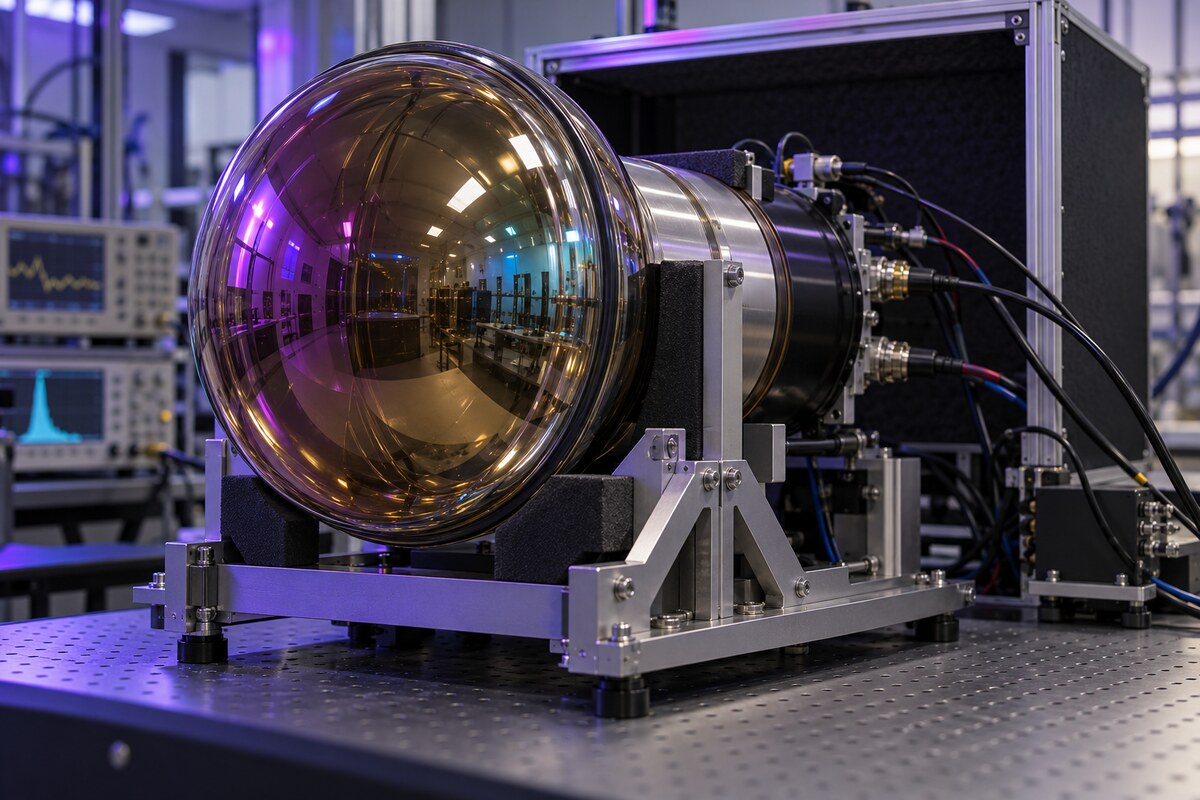
Black-hole systems with jets are candidates for producing the high-energy component of cosmic rays in the Milky Way. In November 2025, scientists using the Large High Altitude Air Shower Observatory in China reported ultra-high-energy gamma rays from five microquasars. Principal investigator Cao Zhen linked the results to research on the cosmic-ray spectrum's “knee,” a steepening around 3 PeV (peta-electronvolts).
The November studies covered SS 433, V4641 Sgr, GRS 1915+105, MAXI J1820+070 and Cygnus X-1. Analysis of SS 433 indicated protons above 1 PeV. V4641 Sgr produced gamma rays reaching 0.8 PeV, with parent-particle energies inferred to exceed 10 PeV. The researchers identified microquasars as likely contributors to the knee's high-energy component, connecting the gamma-ray observations with measurements of cosmic-ray particles.
An observatory that measures air showers
LHAASO stands on Haizi Mountain in Daocheng, Sichuan, at an altitude of 4,410 metres. It detects secondary particles created when high-energy particles interact with the atmosphere. These cascades, called air showers, carry information used to reconstruct the incoming particle's energy and direction.

Construction began in 2017 and was completed in 2021. National appraisal followed in May 2023. The water array records Cherenkov light generated by charged particles moving through water faster than light propagates in that medium. Several detector systems sample the showers across the mountain site:
- 5,216 electromagnetic-particle detectors and 1,188 muon detectors.
- A water Cherenkov array covering 78,000 square metres.
- 18 wide-field-of-view Cherenkov telescopes.
Timing, photodetectors and data acquisition
LHAASO's engineering developments include highly synchronized clock distribution, large photomultiplier tubes, silicon-photomultiplier focal-plane cameras and a trigger-less data-acquisition system. These technologies form parts of the distributed measuring system used for cosmic rays and gamma-ray surveys.
The collaboration also measured the brightness of the Crab Nebula in the ultra-high-energy band, using a familiar astronomical calibration source. The Chinese Academy of Sciences recognised the LHAASO research group with its 2023 Outstanding Science and Technology Achievement Prize on Dec 23, 2023. That recognition followed the facility's national acceptance review earlier that year.

A wide-field gamma-ray catalogue
The first LHAASO gamma-ray catalogue was published on Feb 27, 2024, in the Astrophysical Journal Supplement Series. Its results included 90 very-high-energy sources, of which 32 were new detections in that band, and 43 ultra-high-energy sources. Both sets refer to energy-band detections in the first published catalogue.
LHAASO can monitor approximately one-seventh of the sky at a time and scan around two-thirds each day. Its Water Cherenkov Detector Array and Kilometer Square Array provide complementary coverage for very-high-energy and ultra-high-energy observations. The survey programme identifies sources for more detailed investigation, including pulsar wind nebulae. The catalogue combines the observatory's broad field of view, high observing duty cycle and sensitivity in these energy bands. Continued data accumulation is expected to improve sensitivity and reveal further sources; the published 2024 counts are a dated catalogue, rather than a prediction of the final number.
The Cygnus bubble and a stellar association
A February 2024 Science Bulletin study identified a large gamma-ray bubble in the Cygnus star-forming region. Several detected photons exceeded 1 PeV, and the highest reached 2.5 PeV. The researchers inferred an accelerator capable of supplying cosmic-ray particles with energies up to approximately 20 PeV. Gamma-ray intensity was correlated with the distribution of surrounding gas.

The massive stellar association Cygnus OB2, near the bubble's centre, was proposed as the accelerator candidate. Its young, hot stars drive powerful stellar winds. Collisions between those winds and the surrounding medium offer possible particle-acceleration sites. In the study's interpretation, energetic cosmic rays interact with interstellar gas and generate the observed gamma rays. The inferred parent-particle energy and the measured photon energy are different quantities. The researchers also connected the extended cosmic-ray population around the bubble with excess diffuse gamma-ray emission from the Galactic plane, presenting a possible explanation that can be tested with further observations.
A gamma-ray source along a pulsar's tail
More than 1,200 days of LHAASO observations revealed a gamma-ray source along the tail of the bow-shock nebula associated with PSR J1740+1000. The February 2025 results gave a detection significance of 17 standard deviations. This middle-aged pulsar is approximately 4,500 light-years away and has a characteristic age of 110,000 years.
The gamma-ray source lies about 16 light-years from the pulsar, along the extension of its comet-like X-ray tail. Photons exceeded 300 tera-electronvolts (TeV). The researchers interpreted the geometry and radiation as evidence for energetic-particle processes in the nebula's tail, potentially reaching PeV energies. A pulsar wind nebula forms where a rotating, magnetized neutron star's particle wind interacts with its surroundings. A pulsar moving supersonically through interstellar material can produce a bow-shock structure. The LHAASO result concerns radiation from the tail region, extending observations that had already shown the structure at radio and X-ray wavelengths.

Using the Sun's shadow as a magnetic probe
The Sun blocks some Galactic cosmic rays and creates a deficit, or shadow, in their observed arrival directions. Magnetic fields between the Sun and Earth deflect these charged particles, shifting the shadow's position. LHAASO measured those daily changes using data collected from March to October 2021.
The study, published in September 2024, reconstructed variations in the interplanetary magnetic field. The changes preceded corresponding measurements by near-Earth spacecraft by 3.31 ± 0.12 days. The comparison model gave a lead of 2.06 ± 0.04 days. The collaboration therefore presented the Sun-shadow measurements as another way to investigate the magnetic field across interplanetary space. This result uses changes in cosmic-ray arrival directions, whereas gamma-ray source studies use radiation associated with distant accelerators. The measured lead belongs to that observing period and comparison; it is not a guaranteed warning time for every solar disturbance.
W51 and an inferred acceleration limit
The W51 complex contains active star formation and the supernova remnant W51C. LHAASO extended its measured gamma-ray spectrum into the ultra-high-energy range. The July 2024 study found a bend at gamma-ray energies of tens of TeV, adding a high-energy measurement to a region previously known for lower-energy radiation.

The LHAASO spectrum connected smoothly with Fermi-LAT measurements at lower energies. Together, the measurements spanned six orders of magnitude in gamma-ray energy. The authors interpreted the radiation as evidence for cosmic rays colliding with molecular clouds and inferred a cosmic-ray acceleration limit around 400 TeV. They identified W51C as the most plausible accelerator responsible for the broad-band emission. The 400 TeV estimate concerns the parent cosmic rays; the bend at tens of TeV belongs to the gamma-ray spectrum. The association and energy limit are interpretations of the combined measurements, rather than direct observations of individual protons leaving the remnant.
Particle composition around the knee
LHAASO-KM2A measured the all-particle energy spectrum and mean logarithmic mass from 0.3 to 30 PeV using data collected between September 2021 and December 2022. The results were published in Physical Review Letters on Mar 26, 2024. The two measurements address particle abundance and the changing mass composition across the energy range.
The collaboration linked the knee primarily to light cosmic-ray components, protons and helium, and identified an elbow-like feature in the mean-logarithmic-mass measurement. That feature concerns composition, rather than an additional knee in the total-particle flux. The array's large muon-detector system and high-altitude location supported calorimetric energy measurements designed to reduce dependence on assumptions about particle composition and hadronic interactions. Reducing that dependence improves the basis for comparing different particle populations; it does not remove all modelling from a ground-based air-shower measurement. The resulting composition information complements searches for astronomical objects that could supply those particles.

Following a gamma-ray burst's afterglow
On Oct 9, 2022, LHAASO recorded more than 60,000 gamma-ray photons associated with GRB 221009A. A June 2023 Science study reconstructed the rise and decline of the burst's tera-electronvolt afterglow. This radiation followed the initial burst as ejected material interacted with surrounding interstellar gas.
The photon flux initially rose by more than a factor of 100 in under two seconds, before a slower increase. The radiation began fading more rapidly roughly ten minutes after the afterglow started. The researchers interpreted that transition in terms of a narrow jet, with an inferred opening angle of about 0.8 degrees. These measurements describe the burst's changing brightness over time and the geometry used to explain it. The reported count is more than 60,000 detected photons; a larger count discussed under relaxed selection criteria was an alternative analysis possibility, not the study's stated detection total.
The high-energy spectrum and absorption
A separate Science Advances study, published on Nov 15, 2023, examined gamma-ray emission beyond 10 TeV from the same burst. LHAASO detected photons reaching approximately 13 TeV without the steep flux decline anticipated by the standard afterglow description. The analysis investigated both the production of the radiation and its passage through cosmic background light.

High-energy gamma rays can be absorbed by diffuse radiation during their journey to Earth, with the absorption depending on photon energy. Under the adopted modelling, the LHAASO spectrum implied infrared background-light intensity around 40% of that expected from existing cosmological models. The authors also discussed alternative particle-physics explanations for unexpectedly weak absorption. Those possibilities included hypothetical axions and departures from Lorentz symmetry. They were interpretations to investigate, not detections of a dark-matter particle or demonstrations that special relativity had failed. The November energy-spectrum study is distinct from the June reconstruction of the burst's light curve.
Helium measurements extend the composition picture
The helium-spectrum results published in March 2026 identified a high-energy component that departed from the lower-energy decreasing trend around 1 PeV. A marked fall in helium flux appeared near 7 PeV. These values refer to energy per nucleus and to changes in a measured spectrum, rather than percentages of the detector's output.
The relative abundance of hydrogen and helium also changed with energy. Helium overtook protons around 0.02 PeV; protons became more abundant again around 0.7 PeV and remained dominant until about 5 PeV, above which helium again led. Together with the earlier proton measurements, the helium results indicate a structured mixture of cosmic-ray populations. The collaboration associated the features with contributions from different Galactic accelerators and noted that the detailed mechanisms still require further investigation. Suggested candidates include microquasars and young massive stellar associations, linking the composition measurements with independently observed high-energy gamma-ray sources.

A binary system with orbital modulation
In May 2026, LHAASO extended observations of the gamma-ray binary LS I +61° 303 to approximately 200 TeV. The system contains a massive star and a compact companion, which may be a neutron star or a stellar-mass black hole. Earlier observations had reached roughly 10 TeV.
The measured flux varied with an orbital period of about 26.5 days, and that modulation depended on energy. Photons above 100 TeV placed constraints on the acceleration and radiation processes. Strong magnetic fields cause energetic electrons to lose energy through synchrotron radiation. The researchers therefore suggested that, during particular orbital phases, accelerated protons interacting with the dense stellar wind could produce the ultra-high-energy gamma rays. The interpretation identifies a potential PeV accelerator while leaving the compact object's nature and the detailed emission mechanism open. The orbital variation supplies an additional observable alongside the system's spectrum, allowing models to be compared with measurements at different phases.
The Aquila pulsar-wind nebula
Another 2026 study examined the nebula powered by PSR J1849-0001 in Aquila. Its gamma-ray spectrum extended to approximately 2 PeV. The pulsar's spin-down luminosity is about 50 times lower than that of the Crab pulsar, yet the system emits strongly in the PeV range.

The collaboration combined the gamma-ray spectrum with observations at other wavelengths, including X-rays, to constrain the nebula's physical conditions. The resulting acceleration requirements challenge conventional descriptions of how pulsar-wind particles gain energy at a termination shock. The object was nicknamed the Aquila Booster. The study's efficiency discussion depends on the assumed acceleration model and the inferred properties of the nebula; the observed spectrum itself is a measurement of photon radiation. The comparison with the Crab concerns two different pulsar systems and their energy budgets. Further modelling is needed to explain how the Aquila system produces such energetic emission despite its lower spin-down power.
A longer X-ray trail in September 2026
Joint observations with the Einstein Probe satellite added another measurement of PSR J1740+1000 in September 2026. The satellite revealed an X-ray trail approximately 42 light-years long, aligned with the ultra-high-energy gamma-ray emission found by LHAASO. Earlier XMM-Newton observations had shown a shorter section of the trail.
Researcher Feng Hua interpreted the combined observations as evidence that energetic particles can retain a preferred direction over tens of light-years after leaving an acceleration region. The team considered the X-rays and gamma rays to arise from the same particle population. This is a proposed physical connection between two wavebands measured by different observatories. The 42-light-year figure is the trail's length, while the earlier gamma-ray study's roughly 16-light-year figure described the source's offset from the pulsar. The joint work follows the original gamma-ray detection with a longer spatial view of the surrounding nebula, adding a measurement of particle propagation to the study of acceleration sites.



















Leave a comment