
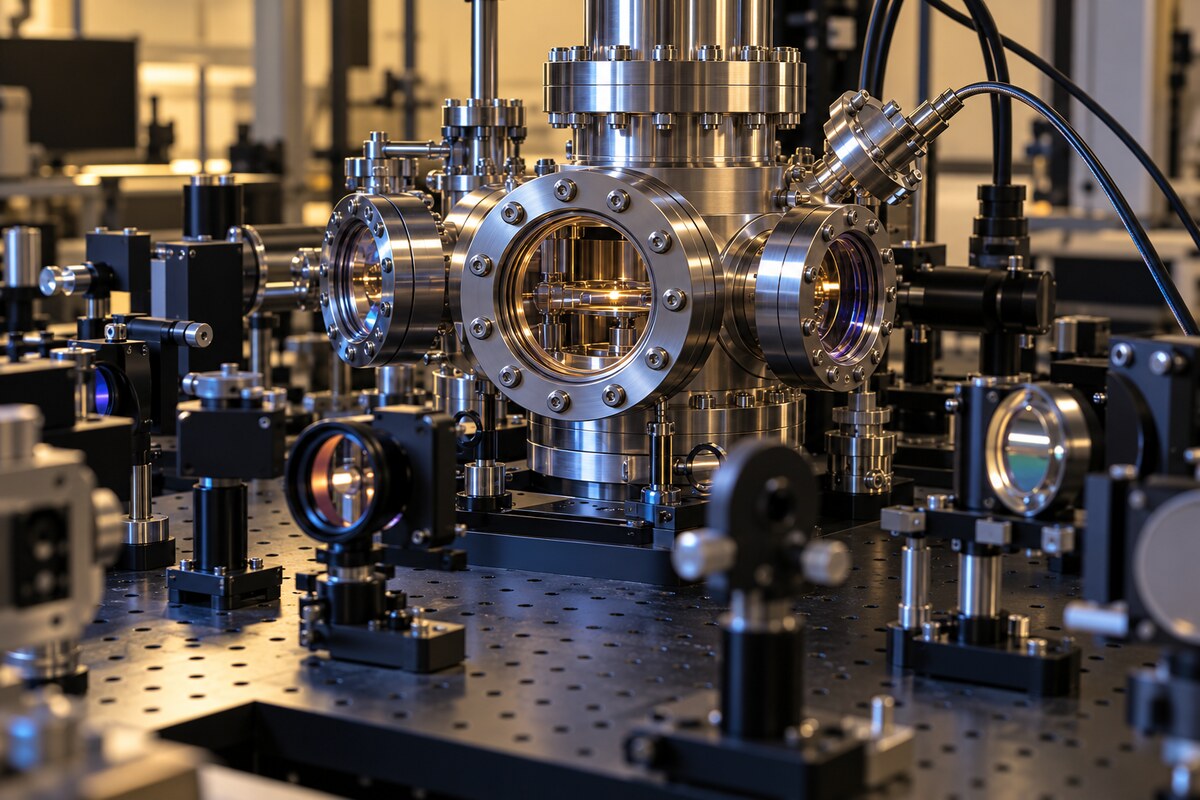
Two studies submitted on Jun 17, 2025 prepared high-quality magic states on Quantinuum’s trapped-ion computers. These states supply operations that are difficult to perform directly on protected quantum information. Shival Dasu’s team detected unsuccessful preparations and discarded them; Lucas Daguerre’s team switched between codes suited to preparation and computation. Dasu’s demonstration used eight qubits, with forty anticipated for a future version. Dasu said early estimates suggested hundreds of thousands might be necessary.
Boris Blinov, a physicist at the University of Washington in Seattle, regarded the work as a missing component of scalable fault tolerance. Quantinuum’s Dave Hayes in Broomfield, Colorado, emphasized magic states’ computational role. Sebastian Weidt, chief executive of Universal Quantum in Haywards Heath, England, highlighted the reduced qubit requirement. The experiments supplied error-resistant operations that outperformed their unprotected counterparts. A complete operation set remains a prerequisite for a useful large-scale machine.

Transport inside the processor
Quantinuum launched H2 on May 9, 2023 with thirty-two physical qubits. Its quantum charge-coupled device architecture, abbreviated QCCD, moved trapped ions around an oval racetrack. The trap incorporated radio-frequency tunnels that carried voltage electrodes beneath its upper surface, connecting the inner and outer regions. Voltage broadcasting reduced the signals needed to move stored ions: three signals controlled twenty wells on each side. These were engineering features of the physical processor, before any choice of how several physical qubits would encode a logical qubit.
A magneto-optical trap replaced an effusive atomic oven for loading, cooling neutral atoms before they entered the ion trap. Fifteen component, system and application tests accompanied the launch. Component measurements included state preparation and measurement, single- and two-qubit gates, transport, and measurement/reset crosstalk. System tests included quantum volume, mirror benchmarking and random circuit sampling. H2 initially remained amenable to classical emulation. Its launch quantum volume of 65,536 was a benchmark result; it did not establish an equivalent speed increase for arbitrary applications or a particular error-corrected algorithm.
More physical qubits, retained controls
The H2-1 upgrade announced on Jun 5, 2024 increased the processor from thirty-two to fifty-six physical qubits. The machine retained all-to-all connectivity, measurement during a circuit, qubit reuse and feed-forward, in which measurement results affect subsequent operations. Ion transport supplied connectivity between pairs without requiring the qubits to remain in a fixed arrangement. Those controls were available alongside the larger qubit register. The fifty-six-qubit specification concerned physical hardware; it was not a statement that H2 contained fifty-six independently corrected logical qubits.

Quantinuum, JPMorgan Chase, Caltech and Argonne National Laboratory also ran random circuit sampling on the upgraded system. Their tests used linear cross-entropy benchmarking, or XEB, to evaluate sampled outputs. Quantinuum estimated an XEB score around 0.35 on its fifty-six-qubit circuits. Circuit geometry, depth and the classical simulation method formed part of that comparison. The company’s claims about the difficulty and energy cost of classical replication were estimates for this benchmark. They did not measure an error-corrected chemistry calculation or establish the performance of every program that could run on the upgraded processor.
Logical qubits and syndrome extraction
Microsoft and Quantinuum announced four logical qubits on Apr 3, 2024, combining Microsoft’s qubit-virtualization system with Quantinuum hardware. Logical encoding distributed quantum information across physical qubits. Active syndrome extraction checked for errors while preserving the encoded information, rather than reading out the computation itself. The teams performed more than 14,000 individual experiments without observing an error. That observation described the tested runs; it was not a guarantee that every later computation would succeed or that any possible circuit could run indefinitely without failure.
Microsoft’s announced improvement of up to eight hundred times applied to a comparison between logical and corresponding physical circuits. The underlying hardware’s two-qubit fidelity was 99.8%, a different measurement from a logical circuit’s failure probability. Syndrome extraction, decoding and correction added operations around the encoded data. The system therefore combined physical gate performance with a method for detecting and handling errors at the logical level. Microsoft placed the experiment in its resilient-computing development stage. Its longer-term expectations for scientific and commercial applications remained forecasts beyond the demonstrated four-logical-qubit experiments.
An earlier encoded algorithm
Quantinuum, QuTech at Delft and the University of Stuttgart had already executed a small fault-tolerant algorithm in 2023. Their one-bit addition experiment, announced on Sep 28, used three logically encoded qubits on H1. A small color code supported the full-adder calculation. Its encoded error was approximately 1.1 × 10⁻³, against approximately 9.5 × 10⁻³ for the unencoded version. The comparison concerned that addition circuit. It did not specify a general error rate for all computations on the processor or establish application-scale fault tolerance.
The experiment combined logical state preparation, Clifford operations, a non-Clifford operation and logical measurement. Transversal controlled-controlled-Z operations in a three-dimensional color-code construction reduced the required two-qubit gates and measurements from more than one thousand to thirty-six. Ben Criger was the principal investigator. QCCD transport allowed the researchers to arrange interactions for their chosen code. The full-adder combined the encoded primitives in one addition algorithm, with its measured improvement tied to that implementation on H1.
Repeated correction during computation
By Sep 10, 2024, Microsoft and Quantinuum had expanded their work to twelve logical qubits on H2. They entangled all twelve in a Greenberger–Horne–Zeilinger, or GHZ, state. The measured circuit error was 0.0011, compared with 0.024 for the corresponding physical circuit, an approximately twenty-twofold improvement. A separate eight-logical-qubit experiment combined logical entangling operations with five rounds of error correction. Its circuit error was 0.002 against 0.023 for the physical comparison, about elevenfold lower. The two ratios belonged to different circuits.

A separate chemistry workflow used two logical qubits on H1. Classical high-performance computing selected a catalyst’s active space and explored reaction pathways; quantum measurements generated classical-shadow data, and an AI model estimated the active-space ground-state energy. A classically calculated reference allowed the team to assess accuracy. The hybrid calculation did not demonstrate scientific quantum advantage, because classical computers could obtain the answer. Its two logical qubits, chemistry task and error-detection configuration were separate from the twelve-qubit GHZ preparation and the eight-qubit repeated-correction experiment. These were several demonstrations, rather than one interchangeable performance score.
Teleporting encoded information
Quantinuum’s logical teleportation experiment, announced on Sep 20, 2024, moved encoded quantum information between groups of physical qubits. The information belonged to a logical qubit, rather than a single unprotected physical qubit. The protocol combined state preparation, entangling operations, measurements during the circuit and conditional operations. Real-time decoding interpreted syndrome measurements and supplied corrections during the protocol. The measured teleportation fidelity was 97.5% ± 0.2%. That number characterized the demonstrated transfer of a quantum state; it was not a physical gate fidelity or a memory error per correction round.
The team tested variants using transversal gates and lattice surgery. Lattice surgery implements logical operations through interactions compatible with two-dimensional nearest-neighbor layouts. Movable trapped ions allowed Quantinuum to explore that approach alongside other interaction patterns. An internal language called Simple Logical Representation expressed the experiments at the logical level, leaving the software stack to implement their physical operations. The experiments ran on H2 alongside customer jobs. IARPA’s challenge required high-fidelity teleportation with fault tolerance, including protocols that kept errors local and correctable. Physical ion movement supplied connectivity even though teleportation transferred the encoded state between registers.

Detecting and discarding errors
The Iceberg code followed an error-detection approach. A detected error caused the computation to be discarded and restarted, rather than corrected within the accepted run. Quantinuum’s Jan 8, 2024 account accompanied research in Nature Physics. The code encoded k logical qubits in k + 2 physical data qubits and required two additional ancillas for syndrome measurement. On H1-2’s original twelve-qubit configuration, the team therefore implemented eight logical qubits. Each logical gate used a two-qubit physical gate, keeping the implementation compact for the circuits investigated.
H-Series ion mobility, measurement during circuits and programmable arbitrary-angle gates supported the implementation. The team used the code to protect circuits more expressive than isolated logical primitives, including a quantum phase-estimation calculation for a hydrogen-molecule simulation. The method combined repeated checks with the decision to retain or discard a run. It did not supply full large-scale fault-tolerant correction. Quantinuum planned further benchmarking to determine whether the code could protect a quantum-advantage experiment and whether it could reduce resource demands in more extensive correction schemes. Those proposed extensions were research goals beyond the demonstrated error-detected circuits.
Physical single-qubit control
Oxford physicists announced a single-qubit operation error of 0.000015% on Jun 10, 2025, approximately one error in 6.7 million operations. Their earlier Oxford milestone in 2014 had been about one in a million. The experiment controlled a trapped calcium ion with microwaves. It operated at room temperature without magnetic shielding. The researchers included David Lucas, Molly Smith, Aaron Leu and Mario Gely at Oxford, with Koichiro Miyanishi at Osaka University in Japan. The announced accuracy concerned a physical single-qubit operation.

Two-qubit operations remained a separate challenge: Oxford put the best error level for those operations at about one in two thousand at the time. Neither figure described an entire logical circuit with repeated measurements and corrections. The work focused on reducing errors in a hardware operation used inside larger computations. Oxford expected improved physical control to reduce the overhead needed for error correction, but the experiment did not measure the resources of a complete useful fault-tolerant computer. Its microwave-controlled calcium-ion setup also differed from the Quantinuum processors used in the logical-operation demonstrations.
Programs that respond to measurements
Quantinuum released Guppy and the Selene emulator on Aug 20, 2025. Guppy embedded a quantum programming language in Python, with static compilation, strong typing and ownership tracking. Its compiler checked constraints including no-cloning and qubit lifetimes. Functions could borrow qubits or take ownership of them; measurement deallocated an owned qubit in the illustrated programming model. These checks concerned program structure and resource handling. They did not remove the physical errors that error-detection or correction codes addressed on the quantum processor. Development tasks included:
- Checking ownership and types before a hardware run.
- Testing branches driven by measurement results.
- Emulating programs with a suitable simulation backend.
Guppy supported measurement-dependent control flow, function calls, custom data types and quantum kernels beyond fixed circuit descriptions. Selene ran compiled programs with noise modeling and the runtime behavior needed for hybrid quantum-classical logic. Its available backends included statevector simulation, stabilizer simulation and classical replay using supplied measurement outcomes. Both tools were open source, and Guppy was available under the Apache 2 license.
A subsequent hardware generation
Quantinuum introduced Helios on Nov 5, 2025 with ninety-eight fully connected physical qubits. Barium replaced ytterbium, allowing control with visible-light lasers. The trap incorporated a junction connecting ring storage, cache and logic zones. Ions moved from storage through the junction for processing, then into leg storage while another group advanced. Sorting could run alongside cooling. A real-time control engine supported measurement-dependent programs and dynamic ion routing. These hardware and control changes accompanied the larger register; the physical qubit count alone did not determine a single logical-qubit capacity.
Helios demonstrations used different encodings for different tasks. Quantinuum entangled ninety-four Iceberg logical qubits with better-than-break-even fidelity, ran an error-detected quantum-magnetism simulation with fifty logical qubits, and produced forty-eight error-corrected logical qubits using code concatenation. Those figures described separate constructions with different protection and encoding rates. Barium also allowed leakage detection and removal at the atomic level. Leakage takes a qubit outside the two states used for computation. The processor’s software and controls had to handle such behavior alongside ordinary errors within the computational states, rather than treating all faulty outcomes as the same event.

Memory scaling and remaining components
On Oct 19, 2026, Quantinuum announced Helios color-code memory experiments at distances three, five and seven. Logical memory errors fell by an average factor of twelve per tested distance increase. At distance seven, the estimated failure probability was 5 × 10⁻⁶ per syndrome-extraction round, corresponding to 99.9995% memory fidelity. The company recorded three failures across approximately 580,000 rounds: 29,000 runs with twenty rounds each. That limited sample supported a per-round estimate; it was not a demonstration of a million-operation algorithm completing without error.
Two-qubit Clifford tests at distances three and five gave a suppression factor of nine, with uncertainty of plus eight and minus four. Leakage repumping returned leaked ions to computational states as correctable errors, while evaluated decoders achieved submillisecond latency. Magic-state preparation, Clifford gates and syndrome extraction remained distinct components of a universal construction. Quantinuum had demonstrated magic-state preparation separately in 2025, but below-threshold scaling of that preparation remained undemonstrated in the October 2026 account. The memory and Clifford measurements therefore retained their own code distances, error definitions and statistical limits.


















Leave a comment