
Mars communications carry commands, spacecraft health information and scientific observations across a distance that changes as Earth and Mars move around the Sun. Signals require minutes to cross that distance. A higher transmission rate can deliver more information during a connection, but it cannot remove the light-travel delay. Future crews would also need communications between people, vehicles and instruments on Mars itself.
MIT communications researcher Vincent Chan considers local radio and existing wireless technologies suitable for nearby users. In his scenario, two small cell towers would serve crews remaining close together. More widely separated explorers would need relays to communicate beyond the horizon. ESA systems engineer Claire Parfitt describes the early MARCONI concept as communications and navigation payloads that could accompany Mars missions and remain available for later users. These are proposals for expanding infrastructure. Operational radio relays, optical-link experiments and proposed local computing address different parts of the communications system.

How an orbital relay works
In July 2025, five NASA and ESA orbiters provided relay services for Curiosity and Perseverance. More than 99% of data travelling to and from the rovers passed through these orbiters and Earth ground stations. The shorter surface-to-orbiter distance allows landed spacecraft to use smaller, lower-power radios. Orbiters carry the equipment needed for the much longer transmission to Earth, while conducting their own scientific investigations.
The proximity radio links use the CCSDS Proximity-1 protocol in the UHF band. Ground teams coordinate opportunities through the Mars Relay Operations Service, or MaROS, which has operated since 2010. The service calculates or supports predictions of:
- periods when an orbiter can see a surface spacecraft;
- data volumes that a relay session can transfer;
- delivery delays and possible overflow of orbital data storage;
- conflicts between requested sessions and available resources.
Operators normally plan relay activities in two-week periods, then handle short-notice changes through a tactical process. Participating teams report the performance of executed sessions. The 2025 participation guide treats demand-access services and more autonomous networking as future capabilities.

The ground network
NASA's Deep Space Network supported more than 40 missions in December 2023. Its 14 antennas were distributed across Goldstone in California, Canberra in Australia, and Madrid in Spain. The geographically separated complexes track spacecraft, transmit commands and receive scientific data. Network schedulers arrange support for critical mission operations alongside the requirements of other spacecraft.
Under the Follow the Sun operating approach, each complex takes responsibility for the entire network during its local day shift. Control then passes to the next complex. JPL manages the network for NASA's Space Communications and Navigation programme. Its history reaches back to portable tracking stations deployed for Explorer 1 in 1958. The stations initially operated largely independently; in 1963 they were connected through JPL's new network control centre, establishing the DSN. That Space Flight Operations Facility remains the point through which data from the three complexes flows. Modernisation includes additional dishes, equipment upgrades and experiments with optical terminals inside radio antennas. NASA expected the mission count to roughly double in coming years, making added capacity part of its December 2023 planning.

Working through solar conjunction
NASA scheduled a pause in commands to its Mars fleet from November 11 to 25, 2023. During solar conjunction, Earth and Mars lie on opposite sides of the Sun. Hot, ionised gas from the solar corona can corrupt radio commands and potentially cause unexpected spacecraft behaviour. Mission teams therefore prepared activities in advance rather than relying on new instructions throughout the pause.
Curiosity and Perseverance were to remain parked while monitoring surface conditions, weather and radiation. Ingenuity's planned observations used its colour camera to study moving sand. Mars Reconnaissance Orbiter and Odyssey would continue imaging the surface, while MAVEN would measure interactions between the atmosphere and the Sun. NASA expected to receive spacecraft health updates during most of the interval, with two days of silence when Mars was fully behind the solar disk. Orbiters would subsequently relay the accumulated science data. Mars Relay Network manager Roy Gladden said teams had spent months preparing spacecraft activity lists. The moratorium concerned commanding and communications reliability; it did not require every instrument to stop collecting measurements.
Acquiring a laser signal
NASA's Deep Space Optical Communications experiment achieved first light on November 14, 2023, at approximately 16 million kilometres from Earth. Its flight laser transceiver travelled aboard Psyche. A beacon from the Optical Communications Telescope Laboratory at Table Mountain, near Wrightwood, California, helped the instrument aim its return laser toward the Hale Telescope at Palomar Observatory in San Diego County. Automated systems refined the pointing at both ends.

Test information travelled through the uplink and downlink during the initial connection. The ground detector collected individual photons, and signal-processing techniques extracted the encoded data. Those photons took roughly 50 seconds to reach Earth during the November test. Throughout that interval, both Earth and the spacecraft continued moving, requiring the pointing system to account for their changed positions. Initial operations also required coordination with Psyche's mission team so that the experimental instrument did not interfere with the spacecraft. Subsequent work would refine the pointing controls and test sustained high-bandwidth transfers over increasing distances.
A preloaded video across deep space
On December 11, 2023, the experiment transmitted a 15-second ultra-high-definition video from about 31 million kilometres away. The encoded signal took 101 seconds to reach Earth, at a maximum rate of 267 megabits per second. Palomar received the transmission and forwarded its frames to JPL, where the looping clip could be played. The video showed Taters, a JPL employee's orange tabby cat, chasing a laser pointer.
The clip had been loaded before launch. It was a test file rather than footage recorded aboard Psyche. Its overlaid graphics included the spacecraft's trajectory, the Palomar telescope dome, laser information and the data rate. Project manager Bill Klipstein explained that Psyche did not generate video, so the experiment ordinarily used randomly generated test packets. The demonstration also tested different downlink rates: during a December 4 session, the team achieved 62.5, 100 and 267 megabits per second and downloaded 1.3 terabits. Flight operations lead Ken Andrews described progressively longer connections with the spacecraft and ground terminals as the team gained experience during checkouts.

Combining radio and optical reception
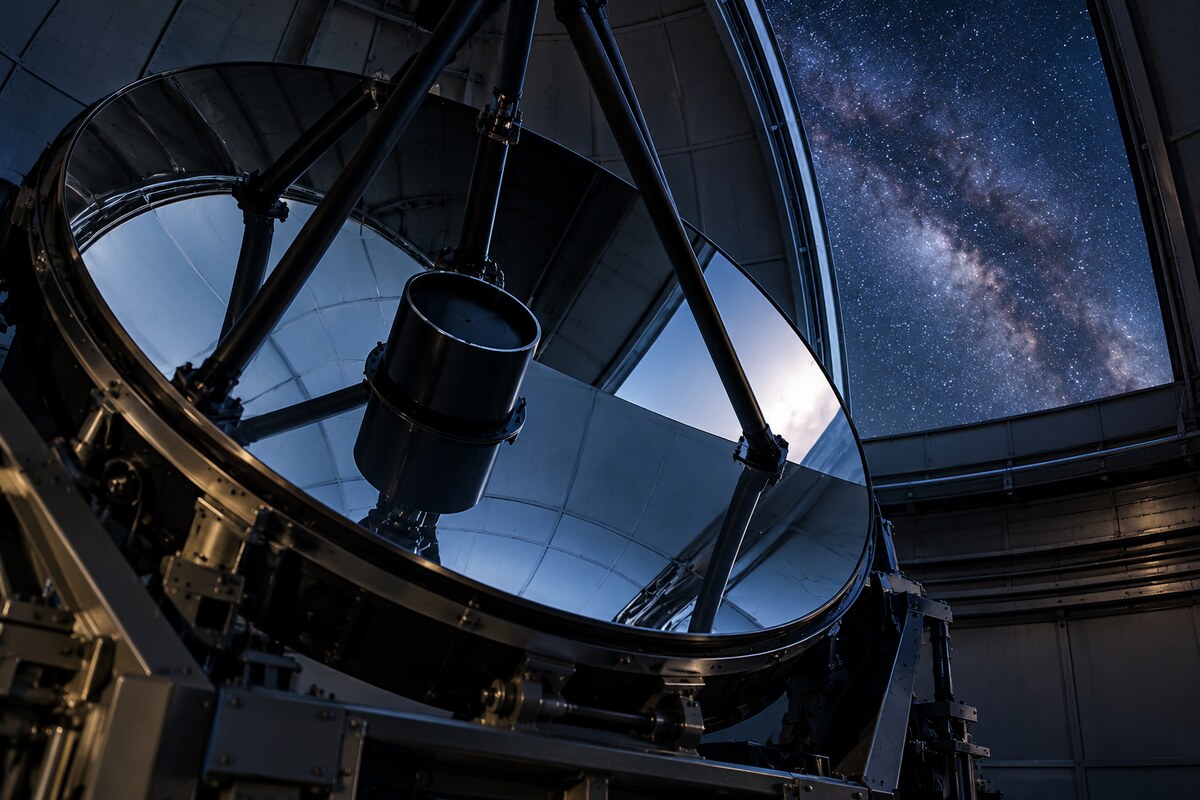
Deep Space Station 13 at Goldstone demonstrated simultaneous reception of radio and near-infrared signals from Psyche. The experimental 34-metre dish was fitted with seven precise mirror segments that together collected light like a one-metre telescope. The mirrors directed photons toward a camera above the dish, then through optical fibre to a cryogenically cooled photon-counting detector. The camera was attached to the antenna's suspended central subreflector. Sensors and cameras maintained the alignment on the flexible antenna structure.
During late 2023, the hybrid antenna received data at 15.63 megabits per second from roughly 32 million kilometres away. On January 1, 2024, it downlinked a photograph of the project team that had been uploaded before launch. The hybrid antenna was a separate experiment, using the DSOC signal as a test source. Ground systems engineer Barzia Tehrani described a possible larger version with 64 segments, corresponding to an eight-metre optical aperture. That remained a proposed expansion. The approach could let existing ground facilities receive large optical data transfers while retaining radio capabilities for less demanding telemetry, including spacecraft health and position information.
Transmitting spacecraft engineering data
On April 8, 2024, DSOC transmitted about ten minutes of duplicated Psyche engineering data from more than 226 million kilometres away. The optical system interfaced with the spacecraft's communications system, allowing it to send newly generated information instead of relying exclusively on preloaded demonstration files. Psyche simultaneously transmitted information over its radio link to the Deep Space Network, while Palomar received an optical copy. Teams at JPL checked the two deliveries.

The experiment achieved a maximum test-data rate of 25 megabits per second during that pass, above its goal of at least one megabit per second at that distance. Psyche's operational mission continued to use radio; the optical demonstration was an additional test. Other experiments sent information up to the spacecraft and back to Earth during one night, over a round-trip path of up to 450 million kilometres. Engineers also combined reception at Palomar, Goldstone's experimental hybrid antenna and Table Mountain. Such arraying lets several receivers collect the same weak signal. Receiver electronics lead Ryan Rogalin noted that storms had interrupted optical operations at the ground sites.
Keeping the optics steady
Spacecraft vibrations can disturb the direction of a narrow laser beam. Controlled Dynamics Inc. of Huntington Beach, California, developed a platform whose struts and actuators isolate delicate equipment from movement elsewhere on its host spacecraft. For DSOC, the assembly supports the flight laser transceiver, supplying active stabilisation and precise pointing. Project manager Bill Klipstein described the requirement to measure pointing without bumping into the surrounding spacecraft while the transceiver is isolated.
NASA began supporting the platform's development in 2012 through its Game Changing Development programme, followed by Small Business Innovation Research support. Early flight tests in 2013 led to an International Space Station opportunity in 2016. Further commercial suborbital campaigns exposed the technology to boosts, thruster firings, pyrotechnic shocks, re-entry and landing forces. Tests involved Blue Origin, UP Aerospace and Virgin Galactic; a photographed flight aboard VSS Unity took place in February 2019. Company co-founder Scott Green credited five separate campaigns over eight months with developing flight maturity before the move into deep-space use. DSOC carried the platform when it launched with Psyche on October 13, 2023.

Data rates at greater distances
The optical experiment reached a sustained downlink rate of 6.25 megabits per second on June 24, 2024, with a maximum of 8.3 megabits per second. Psyche was about 390 million kilometres from Earth. A 45-second demonstration video transmitted during that session combined scenes of Earth and space with imagery inspired by historical television test patterns. Those files, like other demonstration artwork and pictures, had been stored before launch.
On July 29, the ground station sent an uplink signal to Psyche from approximately 460 million kilometres away. The first operational phase ended shortly afterwards. By its October progress update, the project had downlinked almost 11 terabits. Project technologist Abi Biswas said the tests had met a goal of demonstrating a data-rate reduction proportional to the inverse square of distance. The rates varied substantially across the experiment's observing distances. Engineers planned a November 4 power-up and short functional checkout after powering the transceiver down, followed by a second phase of operations after solar conjunction. That restart was still a planned activity at the time of the October update.
The completed demonstration
By September 18, 2025, DSOC had completed its 65th and final pass. It exchanged a laser signal with Psyche from about 218 million miles away during that last session. Across the experiment, its ground terminals received 13.6 terabits. Its longest reported optical downlink occurred on December 3, 2024, when Psyche data arrived from 307 million miles away. These were communications tests aboard the asteroid-bound spacecraft, rather than transmissions from a Mars surface station.

Project technologist Abi Biswas described operational difficulties extending beyond the optical hardware. Weather closed ground stations, and Southern California wildfires affected members of the team. Weekly transmitting and receiving sessions gave operators opportunities to refine performance and add capabilities. NASA's Technology Demonstration Missions programme and its Space Communications and Navigation programme funded the experiment, managed by JPL. The former sits within the Space Technology Mission Directorate; the latter belongs to the Space Operations Mission Directorate. Arizona State University led the separate Psyche science mission. The 2025 completion announcement presented optical communications as an addition to conventional radio for future mission requirements.
A proposed local computing network
Tobias Pfandzelter and David Bermbach of TU Berlin in Germany proposed a different infrastructure element in their June 2023 orbital-server study. Their preliminary design used 81 satellites: nine orbital planes containing nine satellites each, at an altitude of 1,120 kilometres. Optical links between satellites were an assumption of the model. The design's maximum predicted ground-to-satellite-server round-trip delay was 12.5 milliseconds, not an Earth-to-Mars delay.

Computing resources on those satellites could process rover or instrument data, support collaboration between local users, and cache files arriving from Earth. A first request could populate a local cache, letting subsequent users retrieve the same file without another interplanetary transfer. Files could also be pushed into caches in advance when requests were predictable. Filtering and aggregation could reduce outgoing data volumes. These were proposed applications, not deployed services. The authors left hardware design and detailed radiation comparisons for further research. Their radiation calculation used effective dose, a measure relevant to humans that does not directly qualify electronics. Weather, transportation exposure and the feasibility of the complete system also remained research questions.


















Leave a comment