
Three possible beginnings
Phobos and Deimos are small, irregular moons with circular, stable orbits around Mars’ equator. Those paths complicate the idea that Mars captured two intact asteroids. A giant impact could instead have supplied debris from which moons assembled. Planetary scientist Jacob Kegerreis of NASA’s Ames Research Center and colleagues proposed another possibility: Mars captured part of an asteroid after gravity tore it apart. A temporary debris ring could then produce moons already following circular orbits.
Hundreds of simulations explored encounters with different asteroid sizes, speeds and spins. Rings formed across a range of conditions, although that does not establish how these particular moons originated. Returned Phobos samples could help test the alternatives: Mars-like compositions would favour an impact, while asteroid-like material and compounds vulnerable to impact heating would favour disruptive capture. Kegerreis also considers such processes relevant to understanding possible moons around extrasolar planets.

A rover handed over
The MMX mission connects that scientific question to a chain of observations and physical samples. Its IDEFIX rover arrived in Japan from Europe in mid-February 2024. On March 7, CNES of France and the German Aerospace Center, DLR, of Germany, completed the official handover to JAXA in Kamakura. Final checks at Mitsubishi Electric Corporation, known as MELCO, found no abnormalities before acceptance. The rover would explore Phobos before the main spacecraft’s landing, examining the surface material and acquiring calibration information for scientific observations.
The handover also marked a change in integration responsibilities. DLR project manager Markus Grebenstein described almost five years of development behind the vehicle. CNES project manager Stephane Mary emphasized the need for a design compatible with different possible regolith surfaces. JAXA project manager Yasuhiro Kawakatsu identified the next task as assembling spacecraft components and mission instruments developed independently and in parallel. JAXA and MELCO would integrate those contributions into the complete spacecraft. The collaboration followed earlier work with CNES and DLR on the MASCOT lander carried by Hayabusa2.
Measurements beside the wheels
IDEFIX’s science payload links surface conditions to observations from above and later laboratory analysis. Its four instrument classes examine the landscape, wheel tracks, minerals and thermal behaviour. Navigation cameras look in the driving direction and provide colour information, with an imaging resolution of one millimetre at a distance of one metre. White LEDs permit observations at night. Two WheelCams look at the contact between wheels and ground, where track depth and structure can reveal physical properties of the regolith.

Two further instruments examine minerals and heat:
- The RAX Raman spectrometer examines material beneath the vehicle to identify minerals and variations between grains.
- The miniRAD radiometer observes brightness temperature through day and night in six thermal infrared bands, supporting estimates of thermophysical properties and emissivity.
These measurements complement the spacecraft’s remote instruments rather than duplicate a returned sample’s laboratory examination. The 2024 rover plan envisaged release during a landing rehearsal, autonomous uprighting and deployment of its solar generator. Communications and commands would pass through the MMX spacecraft, with rover control centres in Toulouse and Cologne. The estimated surface lifetime was at least one hundred Earth days.
Elements from orbit
MEGANE addresses composition through a different signal. The Mars-moon Exploration with Gamma rays and Neutrons instrument measures naturally occurring gamma rays and neutrons from Phobos. Their measurements are intended to reveal elemental composition, including information beneath the immediate surface. That elemental view could help distinguish captured asteroid material from debris associated with an impact on Mars. It is an investigation designed to assess competing origins, with no Phobos composition result yet supplied by the mission.

The Johns Hopkins Applied Physics Laboratory developed MEGANE in partnership with Lawrence Livermore National Laboratory. Its hardware comprises a gamma-ray spectrometer, a neutron spectrometer and an electronics box for instrument commands and data processing. Principal investigator David Lawrence leads the instrument at APL. The development draws on earlier planetary spectroscopy work involving Mercury, the Moon and asteroids. APL researchers Olivier Barnouin and Terik Daly also joined the international science effort to analyse mission observations and returned samples. In the October 2026 mission plan, survey work followed arrival at Mars in 2027; sampling was intended no earlier than 2028, with delivery to Earth in 2031.
Testing a terrestrial stand-in
Ground rehearsals prepare surface investigations before IDEFIX encounters Phobos. CNES engineers used a prototype named Prototypix at DLR’s Planetary Exploration Laboratory near Munich. A terrain yard provided representative obstacles, while gravity remained terrestrial. Two representative navigation cameras supplied stereo images for autonomous route planning. The flight software and command team supported the campaign remotely from Toulouse. The testing therefore addressed equipment and operational behaviour without reproducing every condition of the future landing site.
An early stereo-acquisition problem inverted the left and right cameras in the flight software. After its correction, tests exercised automatic exposure adjustment, obstacle recognition and avoidance of shadowed danger areas. CNES and DLR alternated sessions, sharing a three-dimensional scanner and tracking equipment. Another sequence tilted the prototype toward the Sun, rehearsing the orientation needed to recharge IDEFIX’s batteries. Continuous camera acquisition during that manoeuvre provided material for further navigation testing in Toulouse. Simulators and a flat rover test model formed part of that validation work. These were prototype trials; successful field navigation on Earth was not a completed demonstration of driving on Phobos.

Planning around delayed feedback
The 2025 operations design divides work between control centres at CNES in Toulouse and DLR in Cologne. During surface operations, one centre would execute the current activities while the other prepared roughly the following week. Their roles would then exchange. Shared databases and commanding tools were intended to keep the products consistent, while each centre could use its established telemetry-analysis tools. Scientific and flight-dynamics teams would support both centres rather than be duplicated at each location.
Every rover command and measurement would travel through MMX and JAXA’s ground segment; there would be no direct rover-to-Earth link. Under the baseline communication schedule, an activity requiring a complete data return before new instructions could need at least two Earth days for the feedback loop. Driving, instrument use and battery charging would compete for time and energy. Several Phobos days could be needed to recharge after demanding activities. The nominal driving speed was one millimetre per second, reflecting the low gravity and uncertain surface behaviour. Solar orientation, thermal limits and spacecraft visibility would constrain the daily schedule alongside the scientific targets.
Keeping motion hardware warm
The locomotion subsystem also has to work across cold cruise conditions and repeated Phobos day-night cycles. Its thermal design separates a protected heater zone containing sensitive motors and electronics from colder structural interfaces. Low-conductivity titanium components and insulating interfaces limit heat leakage, while copper straps distribute heat within the warmer zone. Double-layer heating foils connect to different power supplies: the spacecraft’s heating line during cruise and the rover’s battery-powered system during surface operations.

The 2024 verification included thermal-vacuum tests, qualification and acceptance cycling, and thermal balance testing. The complete locomotion subsystem could not be tested together because facilities and time were limited; modules with their release mechanisms and the electronics box underwent separate campaigns. Selected components also survived non-operational exposure to temperatures of minus 140 degrees Celsius or colder and remained functional after warming. That result describes survival followed by recovery, rather than operation at the coldest test temperature. Uncertainties included nighttime battery energy and changing optical properties as dust accumulated. Dust coverage in the thermal study was an assumption for evaluation, not a measured Phobos condition.
Mineral signatures and calibration
MIRS, the MMX InfraRed Spectrometer, is designed to map Phobos and Deimos between 0.9 and 3.6 micrometres. Its push-broom design records a strip of terrain and a spectrum for each position along it. Motion and an internal scanner supply the second spatial dimension, allowing teams on Earth to reconstruct image cubes. Mineral, ice and organic absorption features could help compare surface regions and inform the selection of sampling sites. Those signatures complement other instruments and returned samples.
The 2025 instrument assessment preserved important calibration limits. Ground measurements had insufficient signal for reliable radiometric calibration between 0.9 and 1.5 micrometres. Spectral-resolution estimates beyond 3.2 micrometres were also uncertain because the test signals were weak. Planned observations of bright stars during cruise would extend and refine calibration, rather than represent already completed flight performance. MIRS’s control segment at CNES would coordinate commands with JAXA, while its data-processing centre at the Paris Observatory would decode telemetry, apply geometric and radiometric corrections, and construct calibrated products. Comparing those products with returned grains would connect large-scale spectral patterns to material examined directly.

Two ways to gather material
The sampling hardware collects material differently from the instruments that observe it remotely. NASA’s P-Sampler, mounted on a spacecraft landing leg, uses bursts of high-pressure nitrogen to lift surface material into a collection system. JAXA’s complementary C-Sampler takes a core from below the immediate surface. The pneumatic sampler is a technology demonstration developed by Honeybee Robotics, a Blue Origin company. Both approaches gather material for examination on Earth.
NASA’s October 2026 plan assigned about fifteen percent of the sample to curation at Johnson Space Center’s Astromaterials Laboratory in Houston. Portions would be available for research over subsequent decades. NASA also contributes Deep Space Network communication and navigation support and funding for participating scientists. Its mission contributions were developed through the Discovery Program, managed by Marshall Space Flight Center for the agency’s Science Mission Directorate. The planned sequence placed Mars arrival in 2027, collection no earlier than 2028 and Earth return in 2031. Those dates describe intended future operations, with survey observations preceding the sampling attempts and laboratory work following recovery.
Tracking terrestrial contamination
Contamination control begins before any grain is collected. The MMX curation and sampler teams aim to minimize contaminants, assess their effects and retain reference materials that help identify contamination in returned samples. The 2024 control plan divided targets into organic and inorganic categories. Allowances were mostly set at one thousandth of the expected amount of the corresponding material in a sample. Organic targets included amino acids, hydrocarbons and carboxylic acids; inorganic targets included elements important for isotope comparisons and chronology.

Contamination requirements informed sampler material selection. JAXA cleaned individual coring-sampler flight parts through successive ultrasonic treatments using organic solvents and ultrapure water. Honeybee Robotics applied equivalent cleaning to the pneumatic sampler. During assembly, testing and launch operations, nitrogen purging and positive pressure protected the sampler hardware. Monitoring coupons included glass dishes, sapphire disks and carbon adhesive tape, while clean-room assessments also included microbial analysis. Sapphire witness plates carried with the sampler would later be recovered and examined to assess contamination during flight. These controls help assess whether recovered signals have extraterrestrial origins.
From container to individual grains
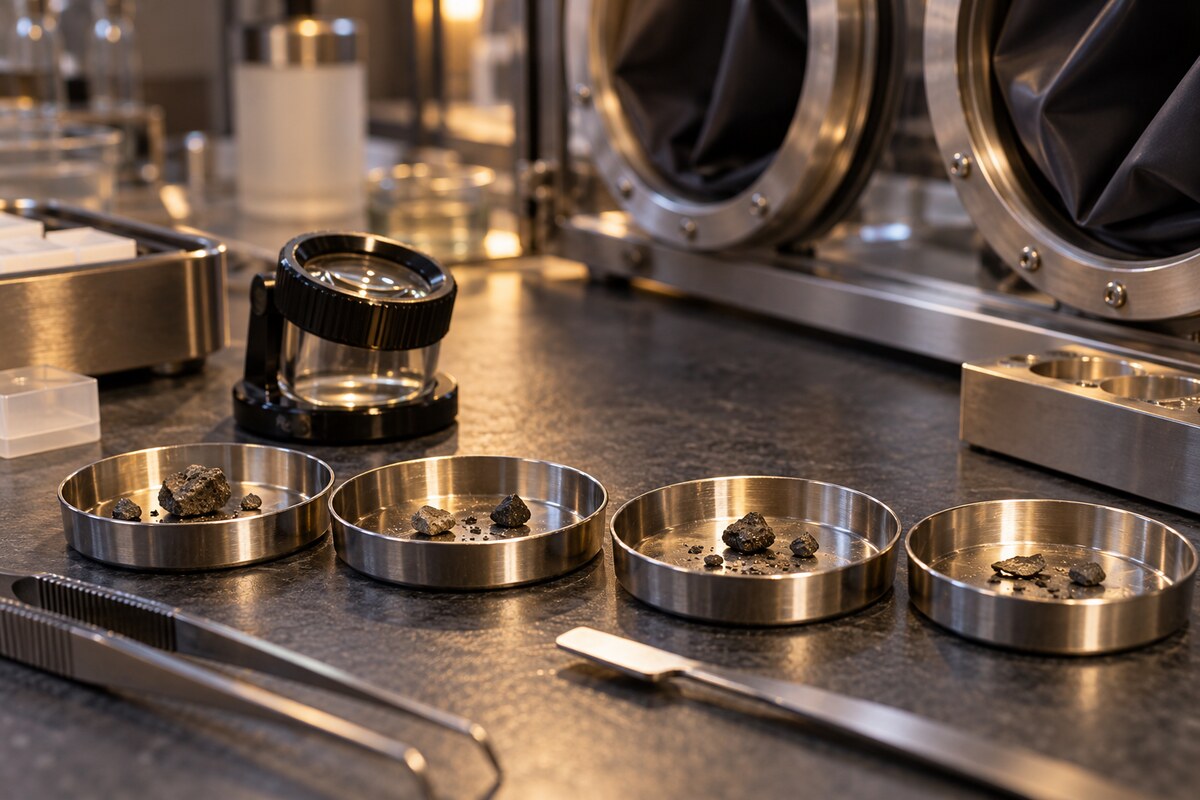
The 2023 curation protocol places recovered material inside a clean chamber under purified nitrogen. Its proposed sequence proceeds from gas to bulk material and then to selected grains, with preliminary examination feeding information back into sample allocation. Quick analysis would extract the container’s headspace gas and evaluate leakage and contamination. That gas could include contributions from solar wind, Phobos, the Martian atmosphere and terrestrial air. Distinguishing those sources is part of interpreting the container’s contents, rather than assuming a single origin for every volatile.

Subsequent characterization would weigh the material and use optical, visible multiband and infrared observations before allocating samples for more detailed examination. The plan connects curation with the MIRS, OROCHI, MSA and RAX instrument teams, including ground-based counterparts that help compare laboratory and spacecraft measurements. Its analytical questions include mineralogy, chemistry, isotopic composition and chronology. Oxygen-isotope measurements would contribute to testing capture against impact origins, while infrared mapping and Raman spectroscopy would help investigate different minerals within the grains. The selection of aliquots would respond to preliminary petrologic and chemical findings, matching material to the scientific questions rather than distributing every portion identically.
Later mission milestones
MMX’s subsequent launch provides a dated milestone in that planned chain of evidence. JAXA launched the spacecraft from Tanegashima Space Center aboard H3 Flight 10 at 4:41:03 a.m. Japanese Standard Time on October 20, 2026. The same instant was October 19 in UTC. The rocket followed its planned flight, and JAXA confirmed successful spacecraft separation and orbital insertion about one hour, eleven minutes and thirteen seconds after liftoff.

On October 21, JAXA confirmed completion of the initial critical operations phase. That phase covered the sequences establishing spacecraft health after separation, including solar-array deployment, three-axis attitude establishment and release of the medium-gain antenna restraint. Initial instrument-function checks and preparations for outbound cruise operations would follow. These were launch and early-operation achievements, distinct from arrival at Mars, landing on Phobos or returning a sample. The mission’s later scientific tests still depended on those subsequent stages and on interpreting the material and measurements together.

















Leave a comment