
NASA’s Nancy Grace Roman Space Telescope began its journey on August 30, 2026, launching from Kennedy Space Center in Florida in the United States. A SpaceX Falcon Heavy carried the observatory toward a destination near the second Sun–Earth Lagrange point, about a million miles from Earth. The roughly $4 billion project has a five-year primary mission; NASA says its fuel could support another five years.
Roman’s panoramic observations will complement the narrower views of Hubble and James Webb. Julie McEnery, Roman’s senior project scientist, describes its strength as surveying large regions rapidly while retaining sharp images. The planned work includes studies of dark matter, dark energy and planets beyond our solar system. Mustapha Ishak, a University of Texas at Dallas cosmologist involved in Roman’s scientific collaboration, also stresses the potential for discoveries that were not anticipated before launch. The launch starts the mission’s journey, with instrument commissioning still ahead.
Assembly of a shared observatory
Technicians joined Roman’s inner and outer sections on November 25, 2025, in the largest clean room at NASA’s Goddard Space Flight Center in Greenbelt, Maryland. The completed observatory brings together two instruments with different assignments. The Wide Field Instrument will gather the survey images. The Coronagraph Instrument is a technology demonstration intended to improve the ability to photograph faint planets and dusty disks close to bright stars.

The coronagraph team plans three months of observations distributed across the first year and a half of operations. The wide-field programme has a different allocation: three core surveys account for about three-quarters of the five-year primary mission, with the remaining quarter available for other observations developed with the scientific community. NASA plans to release Roman’s data publicly without an exclusive-use period. Its General Investigator Program is intended to support researchers working with those observations. The observatory is named after Nancy Grace Roman, NASA’s first chief astronomer, whose work helped establish space astronomy as a resource for the wider research community. Goddard manages the mission, with participation from JPL, Caltech/IPAC and the Space Telescope Science Institute in Baltimore.
Testing an observatory before flight
Roman’s environmental campaign examined electrical interference, vibration and sound. In January 2026, engineers surrounded the observatory with an absorbing panel for an electromagnetic interference test. With the electronics powered, they measured the signals the equipment generated and watched for errors. The arrangement blocked outside radio signals and reduced reflections inside the facility, allowing the team to assess interference that could affect faint infrared measurements.
Vibration testing followed in February, using a shaker table to reproduce launch loads across increasing frequencies. In early March, an acoustic chamber exposed the observatory to sound reaching 138 decibels. Roman passed these assessments. A portable clean room protected it during movements between facilities. The March milestone still left smaller checks ahead, including a test of the shock associated with separation from the rocket and deployment checks for elements stowed during launch. Jack Marshall, the observatory integration and testing lead at Goddard, said the tests were consistent with the team’s expectations.

A final inspection of the light path
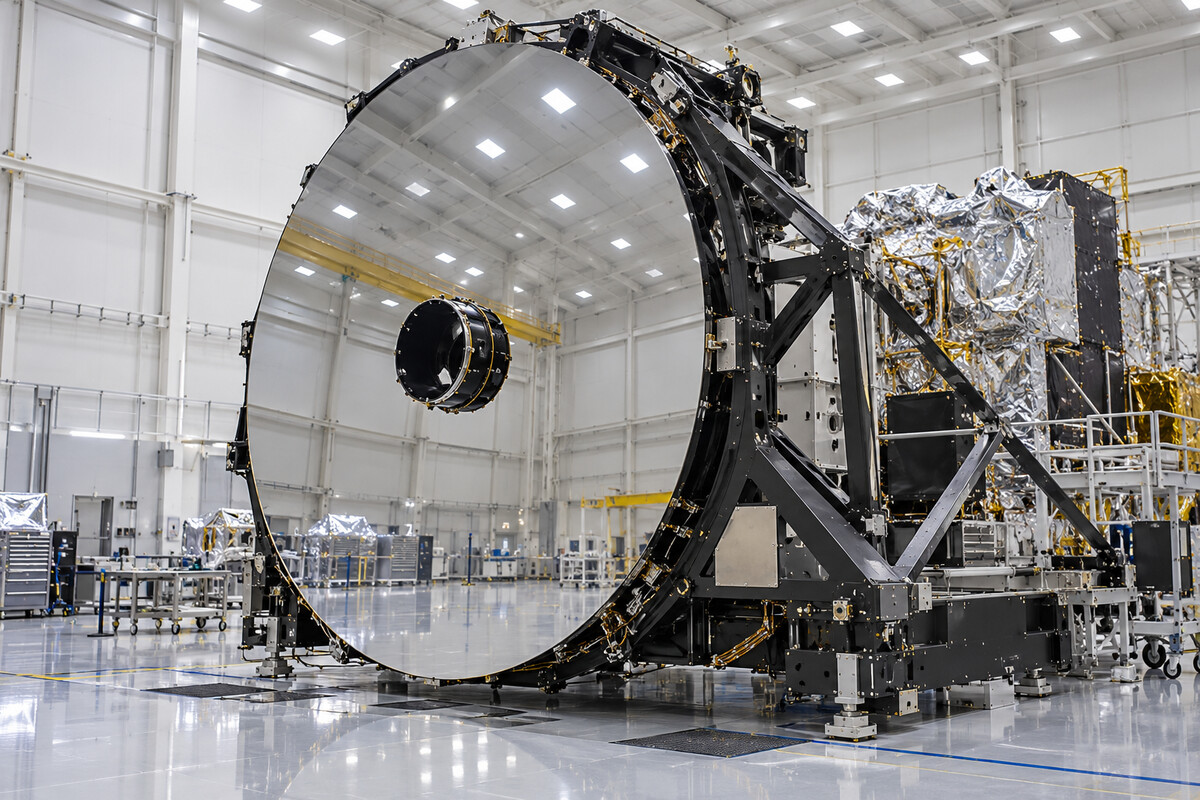
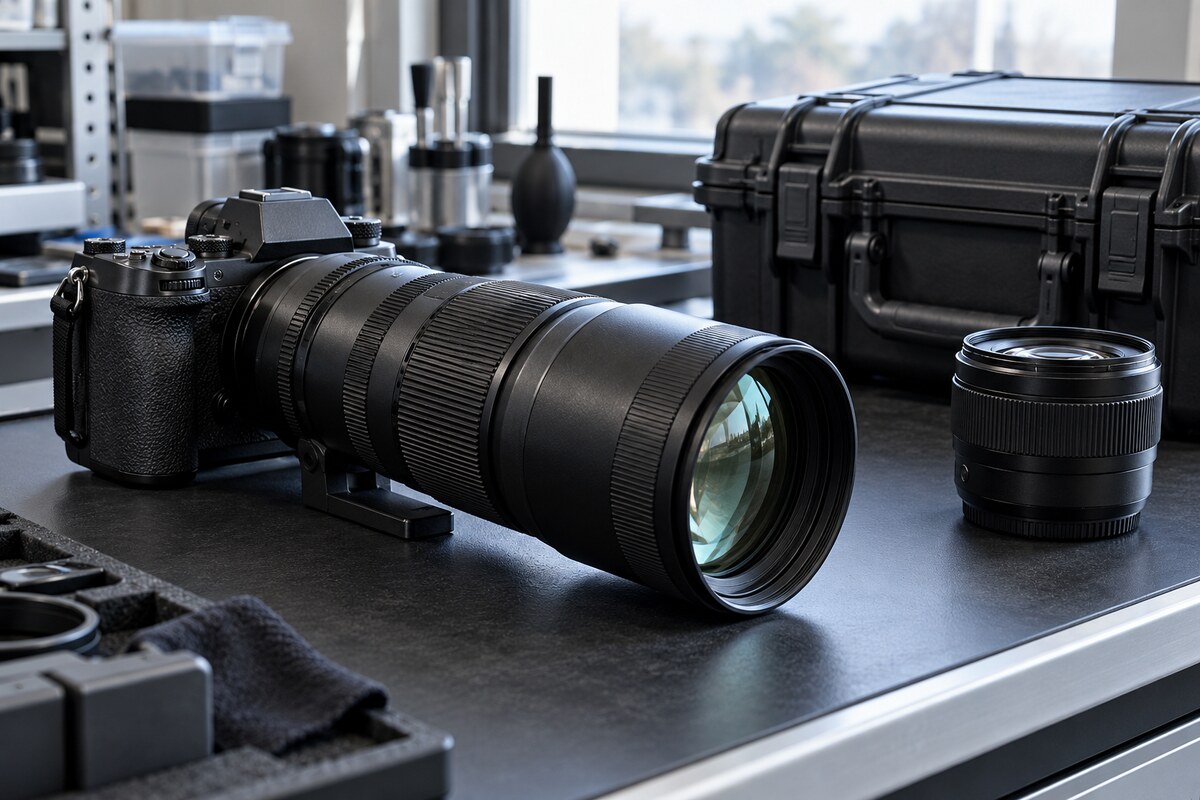
Engineers inspected Roman’s 2.4-metre primary mirror on May 20 and 21, 2026. They turned the observatory onto its side and deployed its protective hood, then used a high-resolution camera with a powerful zoom lens to examine the optics. The inspection checked for particles deposited during testing and for changes along the route light takes toward the Wide Field Instrument. The team confirmed that the optical alignment remained intact after the observatory’s shake test.
The mirror has a silver coating less than 400 nanometres thick, chosen for its near-infrared reflectivity. Its average surface bump is only 1.2 nanometres high, more than twice as smooth as the mission requires. The underlying ultralow-expansion glass resists changes in shape as temperatures change, preserving the optical figure. These material choices differ from the aluminium and magnesium fluoride on Hubble’s mirror and the gold on Webb’s mirrors, which serve different wavelength ranges. Bente Eegholm, Roman’s optical assembly optics lead, reported that the mirror passed the inspection. With the light path checked, the observatory could move toward shipment and launch preparations.
The camera and its optical choices
The Wide Field Instrument arrived at Goddard in August 2024. About the size of a commercial refrigerator, it emerged from a development effort involving around 1,000 people and roughly a million components. Goddard and BAE Systems in Boulder, Colorado, collaborated on its design. Suppliers of important parts included Teledyne Imaging Sensors, Northrop Grumman, Honeybee Robotics, Alluxa and JenOptik. Components were assembled and tested before delivery for observatory integration.

Light entering the instrument passes through an element selected on a large wheel. The optical elements provide different measurements:
- Filters isolate particular wavelength bands for imaging.
- A grism disperses light into spectra.
- A prism also separates light into its constituent colours.
The spectral patterns carry information about the objects producing the light. An array of 18 detectors receives it. Their planned operating temperature is about minus 184 degrees Celsius, supporting sensitivity to infrared signals. The instrument combines images with spectral measurements while observing large patches of sky. Its design calls for stable, precise measurements of the light reaching individual pixels, alongside the broad coverage needed for a survey mission. Mary Walker was the instrument’s manager at Goddard.
Designing a wide-area observing programme
Roman’s survey designs drew on two years of contributions from more than 1,000 scientists at over 350 institutions. Committees considered the research topics that different observing strategies could support before recommendations were received in April 2025. The programmes provide datasets for investigations, from galaxy evolution and cosmic voids to the distribution of matter between galaxies. Gail Zasowski, co-chair of the Roman Observations Time Allocation Committee, emphasised that the surveys were developed for broad scientific use.

The High-Latitude Wide-Area Survey combines imaging and spectroscopy across several components covering more than 5,000 square degrees, about 12% of the sky, in just under a year and a half of observing time. Its main component covers about 2,500 square degrees with multiple filters and spectroscopy. A broader component uses one filter, while a smaller deep component targets fainter galaxies. Looking away from the Milky Way’s dusty plane gives a clearer view of distant galaxies. Their shapes and distribution will support investigations of dark matter’s gravitational effects and the expansion associated with dark energy.
Returning to the same sky
The High-Latitude Time-Domain Survey is designed around repeat visits. Its planned 180 days of observations are distributed over five years, mostly within two years near the middle of the mission. During that main campaign, Roman will revisit fields every five days. Early observations establish a baseline. Subtracting an earlier image from a later one removes much of the static sky, helping researchers identify new or changing sources.
A separate extended component will revisit some fields about every 120 days to capture longer-lasting events. The programme includes northern and southern observing regions; Roman’s spectroscopy is assigned to the southern region, with the ground-based Subaru Observatory providing spectroscopic follow-up in the north. One objective is to find tens of thousands of type Ia supernovae. Comparing their known intrinsic brightness with their apparent brightness gives distances, while their spectra help trace recession. Masao Sako, a survey committee co-chair, expects these measurements to extend studies of cosmic expansion. The survey will also search for other transients, including stars disrupted by black holes.

A concentrated view of the galactic bulge
The Galactic Bulge Time-Domain Survey will examine six fields totalling 1.7 square degrees, including one directed at the galaxy’s centre. Its planned 438 observing days are split into six seasons over the five-year primary mission. During intensive observations, Roman will revisit the fields every 12 minutes. This repeated sampling will track changes in brightness and motion among hundreds of millions of stars in a densely populated region.
Microlensing occurs when the gravity of a foreground object bends and magnifies light from a more distant star. A planet around the foreground star can add a brief variation to the signal. Researchers expect Roman to find more than 1,000 planets through this method, including worlds in wider orbits that other approaches struggle to detect. The same observations can reveal variable stars, eclipsing binaries and stellar remnants. Caltech/IPAC’s Roman Science Support Center will handle high-level processing for the bulge survey, with automated monitoring to identify microlensing and other variable events. The cadence and long baseline support multiple investigations using the same sequence of observations.
Planet searches in different populations
Roman will also look for transits: periodic dimming when a planet passes in front of its star. Scientists forecast around 100,000 discoveries through that method. Transit searches favour large planets close to their stars, which block more light and cross frequently. Microlensing probes a different population, including smaller planets in wider orbits. Elisa Quintana’s team at Goddard is preparing software and simulations for the transit observations, extending the search into galactic environments beyond the nearby populations already studied.

Robby Wilson and colleagues are generating synthetic data, finding simulated planets and using machine learning to filter false positives before real observations arrive. Some hot Jupiters may also reveal atmospheric behaviour through changes in infrared brightness. A smaller dip when a planet passes behind its star isolates the planet’s contribution to the system’s light. Tracking that signal around an orbit can reveal temperature patterns and differences between day and night. Wilson distinguishes this statistical approach from Webb’s detailed chemical studies of individual atmospheres. The expected planet counts and atmospheric measurements remain research forecasts for the planned programme.
Testing starlight suppression
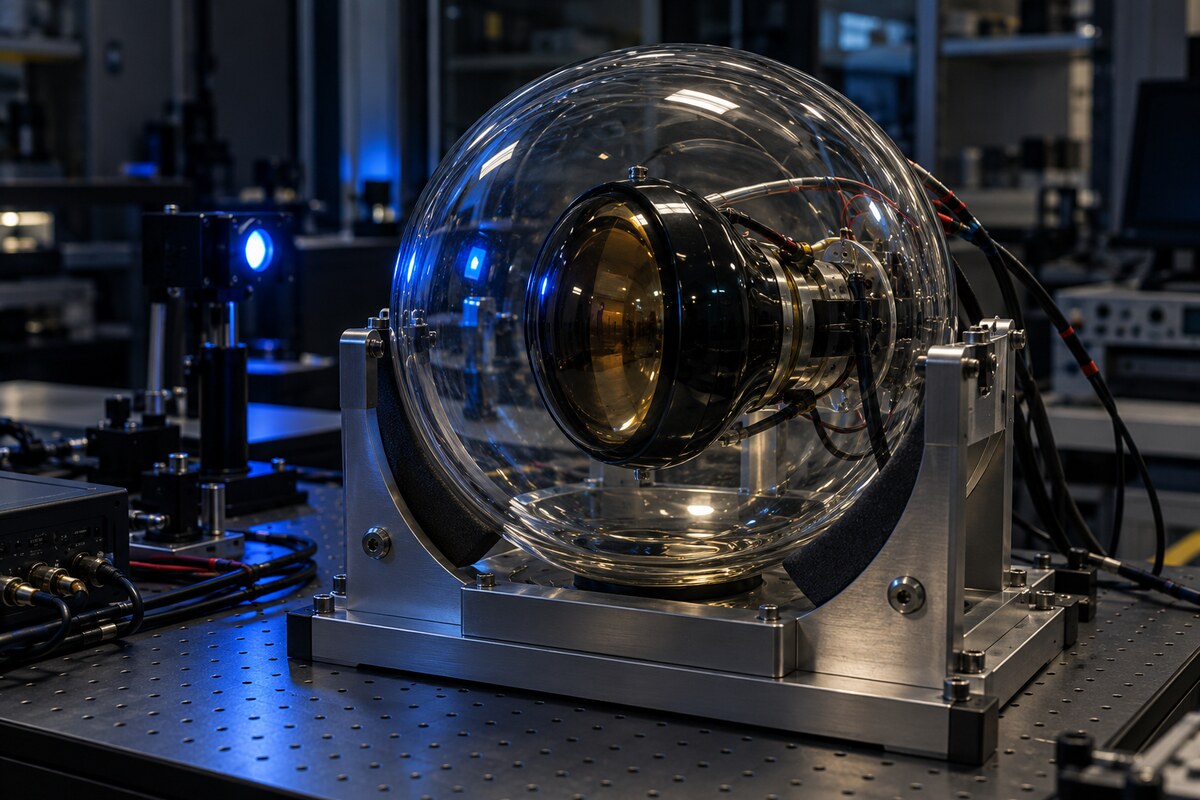
The Coronagraph Instrument followed a development path at NASA’s Jet Propulsion Laboratory. Before shipment to Goddard in May 2024, it underwent a vacuum-chamber test using lasers and optics to reproduce starlight. Masks blocked the central source while movable components reduced the unwanted light remaining around it. Engineers call the process “digging the dark hole”: the test creates a darker region in which a much fainter nearby object could become visible.
Two deformable mirrors, each about five centimetres across, adjust their shapes to correct stray light and small imperfections in the wider optical system. Those corrections matter for direct imaging even when the imperfections are too small to compromise Roman’s other measurements. The test required adjustments of the optical configuration. Roman’s demonstration aims to extend direct imaging toward cooler, older giant planets closer to their stars than many previously photographed worlds. It is an intermediate technology step for possible future missions such as the Habitable Worlds Observatory, rather than a promise that Roman itself will photograph Earth twins or detect life.

A separate map of the Milky Way’s plane
The Galactic Plane Survey is the first selected general astrophysics programme beyond the three core surveys. Its plan assigns 29 observing days across the mission’s first two years. The main component covers 691 square degrees in 22.5 days. Repeated visits to a smaller 19-square-degree region take about 5.5 days, while small fields totalling around four square degrees receive 31 hours using the full filter and spectroscopy suite.
NASA expects the survey to map up to 20 billion stars, using infrared observations to look through dust that obscures visible-light views. The targets include star-forming regions, nearly 2,000 young open clusters and dozens of older globular clusters near the galactic centre. Comparing clusters across different environments can help researchers study how stars develop: members of a cluster generally share an age, origin and chemical composition. Repeated high-resolution images will also measure small positional changes and identify variable sources. Targets include the Carina Nebula and a 10,000-light-year stretch of its surrounding spiral arm. This broad plane survey is distinct from the longer, more concentrated bulge time-domain campaign.
Communications and commissioning after launch
Ground controllers began receiving Roman’s telemetry seven minutes after launch. The observatory separated from Falcon Heavy 31 minutes into the flight, and NASA confirmed deployment of its solar panels and lower instrument sunshade after an hour and 23 minutes. Early tracking and commands used the Near Space Network. About 70 minutes after launch, the Deep Space Network took over, beginning through Canberra in Australia, with subsequent handovers planned to Madrid in Spain and Goldstone in California.

The commissioning programme still includes antenna and aperture-cover deployments, course corrections and instrument activation. The coronagraph is scheduled to power on within days, followed by the Wide Field Instrument a few weeks into the journey. Calibration and testing will continue through the roughly three-month commissioning period. NASA anticipates the first images by early 2027 and a science-data return of 1.4 terabytes per day. Those planned observations will follow the engineering checks that establish the instruments’ performance in their new operating environment.














Leave a comment